
Leadership series: Lee Bennett
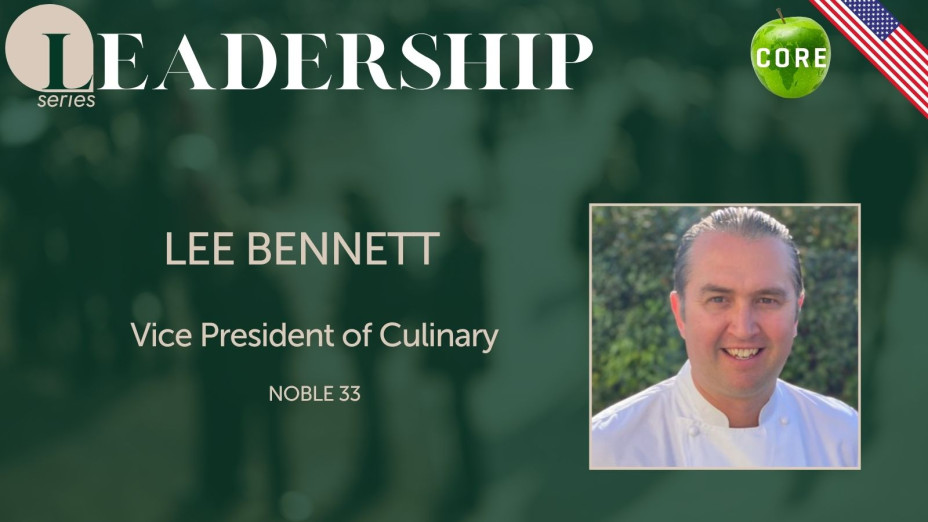
Our CORE Leadership Series puts inspiring industry leaders in the spotlight through exclusive interviews.
We are here interviewing Lee Bennett, Vice President of Culinary - Noble 33
What initially inspired you or sparked your interest in pursuing this career?
I started washing pots at 15 in a local restaurant in Bridlington, East Yorkshire. Very quickly, something clicked once I got into the kitchen, the pace, the intensity, the camaraderie. I knew early on that if I wanted to be among the best, I’d have to make my way to London. The moment that really cemented it for me came when I was 17, working in a small open kitchen at a hotel. A group of my former teachers came in, and I overheard them laughing, saying they weren’t surprised I’d dropped out of sixth form and wouldn’t amount to much. That stuck with me. It became a real source of motivation, not just to prove them wrong, but to prove to myself that this wasn’t a dead-end path. Not long after, I took the leap, spending a year in York to build experience, then moving to London at 19 to see I could work with the best and quickly I was fortunate to get working with Jason Atherton and then never looked back.
What motivates you in your work and what do you find most fulfilling about being a business leader?
At this stage in my career, what motivates me most is building and developing the next generation of leaders. There’s a real sense of purpose in identifying talent, investing in it, and creating an environment where people can grow. There’s a common narrative that younger generations lack work ethic or drive, but that hasn’t always been my experience. Expectations and circumstances have evolved, but there are still many individuals with strong ambition and resilience, they just need the right guidance and opportunity. What I find most fulfilling is spotting that potential, helping shape it, and equipping people with the tools and confidence to succeed. Watching them progress, take on leadership roles, and build their own teams is incredibly rewarding, it’s how you create lasting impact beyond your own day-to-day role.
What skills or mindsets do you think will be most important for the next generation of leaders?
For future chefs who want to succeed, developing a strong understanding of basic finance and building solid digital skills are essential. The days of relying solely on creativity and culinary talent to drive a successful restaurant are gone. Even the most imaginative chefs can struggle to sustain a business without a clear grasp of cost control, margins, and overall financial responsibility. Long-term success now depends on balancing creativity with commercial awareness. I highlight this because I still come across talented chefs who haven’t developed these capabilities. As a leader, I make it a priority to equip them with these skills ensuring they’re not just exceptional in the kitchen, but capable of running and sustaining successful operations.
What is or are your biggest career achievement(s)?
I’ve been fortunate to have a career that’s taken me across the world, from London, Dubai, and Paris to Singapore, Las Vegas, and now Miami, so there have been several proud moments along the way. One that stands out is being appointed Head Chef at The Savoy Grill in 2006 by Marcus Wareing. At 26, I wasn’t ready for that role, but Marcus saw something in me and gave me the opportunity to lead a brigade of 52 chefs. I took that responsibility seriously and was determined to rise to the challenge. He gave me the ball, I ran with it and I wasn’t going to drop it. A few months later, I was nominated for Restaurant Chef of the Year at the Craft Guild of Chefs Awards. I was up against established names like Chris Galvin, who had just opened Galvin at Windows, so I went into the evening simply grateful to be nominated. My wife and I were seated at the back corner of a room filled with industry leaders, and I remember saying we were just there to make up the numbers, but we’d enjoy the evening regardless, which we did. When my name was called, it genuinely caught me off guard and the whole table was shouting at me to go up on stage and collect the award. It was a whirlwind moment, going from sitting in the crowd to standing on stage in front of industry peers I deeply respected. What made it even more special was that one of my chefs at the time, Lahiru Jayasekara (Larry), won the Young Chef Award that same night.
Have there been any hard decisions you had to take as a business leader?
Absolutely, difficult decisions are an inevitable part of leadership, and some stay with you more than others. One of the toughest periods was during the pandemic, when I was overseeing operations at a large Las Vegas property. I had to personally make over one hundred calls to members of my senior F&B team to inform them they were being placed on furlough. It was an incredibly challenging moment, these were people I had worked closely with, and there was so much uncertainty around when, or if, we’d be able to bring everyone back. What made it even more difficult was knowing that the situation was completely out of anyone’s control, while also being aware that I was fortunate to remain in my role. You try to communicate with honesty, empathy, and as much reassurance as possible, but it was a deeply unsettling time for everyone involved. Experiences like that reinforce the human side of leadership, reminding you that behind every decision are real people and livelihoods, and that responsibility stays with you.
What do you see as the most significant challenges and opportunities currently shaping the service industry /sector?
One of the most significant challenges in today’s service industry is the pace at which trends evolve. With the influence of social media and instant global communication, concepts, cuisines, and dining experiences can rise and fall faster than ever before. A couple of decades ago, trends had far more longevity, and restaurants could rely on consistency to build a loyal following over time. Today, staying relevant and continuing to attract repeat guests requires constant evolution without losing your identity. That said, this also presents an opportunity. Operators who can strike the right balance between innovation and consistency, adapting to changing guest expectations while maintaining a strong core offering, are the ones who will stand out. While there are still legacy restaurants around the world that have stood the test of time, for many businesses today, agility is key. Understanding shifting dining habits and building that flexibility into long-term strategy is no longer optional, it’s essential for sustained success.
How do you balance the demands of commercial performance with staff wellbeing, retention and culture building?
Balancing commercial performance with staff wellbeing and culture is one of the most critical and often most challenging parts of leadership. Over the past eleven years working in the U.S., I’ve been able to bring in perspectives and best practices from European operations, particularly around the retention of teams. Following the pandemic, during the period often referred to as the “Great Resignation,” we saw a wave of leaders leaving roles, many without a clear next step and largely due to burnout and fatigue. At the same time, some organizations responded by rapidly promoting individuals to retain them. I felt strongly that this wasn’t the right long-term solution, it risked setting people up for roles they weren’t ready for, while also creating instability within the business. Instead, I worked with my mentor at the time, who was overseeing F&B operations across Park MGM and Bellagio, to implement a more sustainable approach focused on wellbeing and retention. Together, we introduced a structured plan to ensure every salaried leader took a minimum of three weeks off per year. Although flexible time off was already part of their contracts, very few people were actually using it. So, we created a system where, within the first 90 days of the year, every leader was scheduled to take at least one full week off, planned in a way that maintained operational performance. With over 80 leaders involved, it required careful coordination, but it proved highly effective. From there, individual departments were responsible for ensuring the remaining time off was taken throughout the year. The impact was significantly improved morale, better retention, and ultimately stronger, more consistent performance. For me, it reinforced that supporting your people and driving commercial success are not competing priorities. Ultimately what the system showed them is with the right planning and spreading out of the vacation time it was possible for everyone to equally have three weeks off. Our retention levels spiked and from there I introduced that system to Caesars palace when I was director of culinary. A much bigger role that had a hundred and seventy salaried leaders participating but I then learnt the bigger the team the easier it was to implement as it meant we had more resources in house to help provide coverage across the F&B portfolio.
Which innovations — technological, experiential or operational — excite you the most right now?
What excites me most right now and scares me at the same time, is the rapid advancement of robotics in the hospitality and restaurant industry. In 2022, we opened the first Dominique Ansel operation in Las Vegas at Caesars Palace, where I was introduced to the “robot cookie arm.” It allowed guests to access his signature cookie shot 24/7, even outside of operating hours. It was a simple but effective example of how automation can enhance accessibility, guest experience, and generate incremental revenue without compromising the brand. What’s striking is how quickly this space is evolving. In just a few years, we’ve seen significant advancements in robotics and automation being tested across different areas of the industry. I’ll be attending the National Restaurant Association Show (NRA) in Chicago in May, and I’m particularly interested to see what new developments are being showcased. The potential is significant, but the real opportunity lies in understanding where technology genuinely enhances the guest experience and operational efficiency, rather than replacing the human element that remains at the heart of hospitality.
What’s a lesson you learned that still influences your decisions?
Early in my career, I worked with Jason Atherton in Dubai at a time when Gordon Ramsay held the F&B contract for the property. The original room service offering had been designed more like fine dining restaurant food, but it simply didn’t translate well to the environment. Guests didn’t want that style of dining in their rooms, and as a result, many were ordering from outside. Jason was asked by the hotel to address the issue. Although he hadn’t designed the original offering, he quickly recognized the disconnect between product and guest expectation. He reworked the entire menu to reflect what guests actually wanted from room service, while also incorporating local relevance. The result was a much more balanced offering, high-quality execution of familiar favourites like pizza, Caesar salad, chicken tenders, and club sandwiches, alongside locally inspired dishes. I remember him saying something that has stayed with me ever since, “it doesn’t matter whether it’s fine dining, brasserie, fast casual, or room service, what matters is understanding your guest and delivering the best possible version of what they actually want”. That philosophy has influenced my decision-making ever since. It reinforced the importance of respecting the context of each operation, rather than trying to force a concept into the wrong environment. It’s a mindset that has served me well across very different roles, from large-scale casino operations in Las Vegas to global restaurant groups, where success ultimately comes down to balancing creativity with a clear understanding of the local market.
If you could change one policy, trend or misconception about the sector, what would it be?
If I could change one misconception about the industry, it would be the idea that working hard, especially working nights, weekends, and long hours early in your career is inherently a negative thing. When I was in my twenties working what were, at the time, very intense hours in the late 90s and early 2000s, I often had friends question why I was doing it. Meanwhile, many of them were following fairly routine social patterns each weekend. What I’ve learned over time is that both paths are valid but the perception that sacrifice in hospitality is something to be avoided doesn’t reflect the full picture. For me, those early years built discipline, resilience, and a deep understanding of the craft. They also made the moments outside of work, time off, travel, social time, feel more meaningful because they were earned. The key, of course, is balance over the long term. But I do think there’s value in reframing hard work early in a career not as something negative, but as something that can build strong foundations for future opportunity and perspective.
Author
Date Published: 28th April 2026
