
Leadership series: Andres Gonzalez
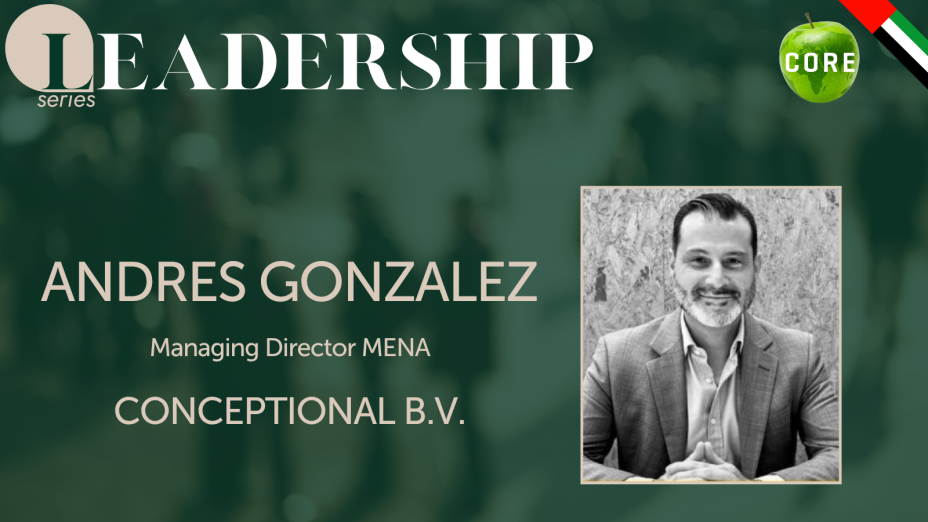
Through our Leadership interview series, we celebrate remarkable industry leaders worldwide by sharing their stories
In this interview, we speak to Andres Gonzalez, Managing Director MENA at Conceptional B.V.
You started as a Restaurant Manager at La Tasca in the UK, then worked your way through Kout Food Group, Landmark Group and Americana across the GCC before founding your own ventures. Talk us through that journey; what’s stayed constant from the restaurant floor to where you are now?
“I started my career on the restaurant floor, and I think that experience shaped everything that followed. As a Restaurant Manager, you learn very quickly that hospitality is fundamentally about people: understanding your customers, building a motivated team and delivering consistently, even when the operation is under pressure.
Moving to the GCC gave me the opportunity to apply those fundamentals on a much larger scale. Through Kout Food Group, Landmark Group and Americana, I progressed from managing individual operations to leading across multiple locations, markets and brands. The complexity increased significantly—I became responsible for larger teams, P&Ls, growth programmes, new openings and operational transformation—but I never lost sight of what was happening at restaurant level.
Working across different organisations and cultures also taught me that a successful operating model cannot simply be imposed from the centre. You need clear standards and commercial discipline, while listening to the people closest to customers.
Founding my own ventures was a natural next step. It allowed me to bring together my operational experience, commercial perspective and understanding of concept development to help businesses solve problems and grow sustainably.
What has remained constant throughout the journey is my belief that results come through people. Whether I am speaking with a team member on the restaurant floor, coaching a senior manager or advising a business owner, my role is to create clarity, establish accountability and give people the confidence and support to perform. The scale has changed, but that principle hasn’t.”
Which shift in the region’s F&B scene will matter most?
“I think the most important shift will be the continued rise of strong homegrown concepts. When I first arrived in the region, much of the market’s growth was driven by importing successful international brands. Those brands will remain important, but consumers are increasingly looking for concepts that feel locally relevant, distinctive and authentic in local terms.
The strongest homegrown businesses understand the region’s culture and customers, but they also operate with the discipline of an international brand. That combination creates an opportunity not only to succeed locally, but eventually to export concepts from the Middle East into other markets.
Health-conscious and non-alcoholic products will also become part of the mainstream rather than remaining specialist categories. AI will be important, particularly in forecasting demand, managing labour, reducing waste and personalising customer communication. However, I see AI primarily as an enabler. Technology can improve the business model, but it cannot replace a compelling concept, genuine hospitality or an emotional connection with the customer.
Ultimately, I believe the winners will combine regional authenticity with strong operational systems and intelligent use of technology.”
Where is the strongest investment opportunity in MENA hospitality?
“I see the strongest opportunity in scalable, locally relevant fast-casual concepts positioned between traditional quick service and more expensive full-service dining.
Consumers increasingly want quality, convenience and value at the same time. That creates space for concepts offering credible food, a strong identity and an enjoyable experience, but with a smaller footprint, simpler operations and a more accessible price point than traditional casual dining.
From an investment perspective, the concept must be designed for scale from the beginning. That means disciplined menus, efficient kitchens, strong unit economics, multiple sales channels and an operating model that does not depend excessively on individual chefs or highly specialised labour.
There will always be opportunities in premium and experiential dining, particularly in major tourism destinations. However, those businesses can be capital-intensive and difficult to replicate. I would be particularly interested in a regional fast-casual brand that can build frequency in its home market and then expand through franchising.
The real opportunity is not simply opening more restaurants; it is developing brands from MENA that have the systems and relevance to travel internationally.”
What leadership lesson from your operating days guides you when advising boardrooms?
“The lesson I carry into every boardroom is that a strategy is only valuable if it can be executed by the people running the operation.
From a boardroom, a proposal may appear commercially attractive and completely logical. But if it adds too much complexity, depends on capabilities the organisation does not have or fails to engage the frontline team, it will not deliver the expected result.
My operating experience taught me to test strategic decisions against the reality of the business. What will this mean for the restaurant manager on a busy Friday evening? Does the team understand why we are doing it? Do they have the training, equipment and resources to deliver it consistently? How will we measure whether it is working?
When advising senior leaders, I therefore try to connect strategic ambition with operational reality. I support ambitious ideas, but I also challenge organisations to be honest about their readiness to execute them.
What will distinguish the leading service providers over the next decade?
“I believe the strongest service providers will combine specialist expertise with the ability to understand the client’s complete commercial picture.
The market is becoming too complex for generic advice. Clients will look for partners who genuinely understand their sector, customers and operating environment. At the same time, being a specialist cannot mean working in isolation. Concept development, customer experience, technology, sustainability and operational performance all need to connect.
The best providers will also be judged less by the reports they produce and more by the results they help deliver. Clients will expect practical recommendations, measurable outcomes and support through implementation.
Technology and AI will make analysis faster, but they will not replace experience, judgement or the ability to influence people. In fact, as information becomes easier to access, those human capabilities may become even more valuable.
The leading providers will therefore be specialised but commercially rounded, technologically capable but human-centred, and able to move comfortably between strategic discussions and operational delivery.”
What skills or mindsets will be most important for the next generation of hospitality leaders?
“The next generation will need to combine traditional hospitality leadership with much stronger commercial and technological capabilities.
They must still be able to engage a team, understand customers and create a strong service culture. Those fundamentals will not change. However, future leaders will also need to interpret data, understand digital channels and use AI effectively. They do not need to become technology specialists, but they must know how to turn information into better decisions.
Adaptability will be equally important. Consumer behaviour, cost structures and operating models are changing very quickly, so leaders cannot rely solely on what worked previously. They need curiosity, resilience and the confidence to challenge established practices.
I would also emphasise cultural intelligence. Hospitality teams and customers are increasingly diverse, particularly across MENA & Tourist driven areas in the UK. Leaders must be able to listen, communicate and build trust across different cultures and generations.
The strongest leaders will combine emotional intelligence with commercial discipline: good with people, comfortable with numbers and always willing to learn.”
What’s the most important leadership lesson you’ve learned?
“The most important lesson I have learned is that leadership is not about having all the answers; it is about creating the conditions in which people can succeed.
Earlier in your career, it is easy to believe that leadership means personally solving every problem. As your responsibilities grow, you realise that this approach limits both you and the organisation. Sustainable performance comes from establishing clear expectations, developing capable people and giving them genuine ownership.
That does not mean removing accountability. People need to understand what success looks like and know that performance matters. But they also need the freedom and confidence to make decisions.
I have found that when people understand the purpose, contribute to the solution and feel trusted to deliver it, their level of commitment changes significantly.
My role as a leader is therefore to provide clarity, remove obstacles and hold people accountable—while creating an environment in which they can grow beyond their current capabilities.”
Are you expecting consumer expectations to shift this year?
Yes, although I see it as an acceleration of changes already underway rather than a completely new direction.
Consumers will become more demanding about value, but value will not simply mean the lowest price. They will assess whether the quality, portion, convenience, service and overall experience justify what they are paying.
I also expect greater polarisation in spending. Customers may become more selective about routine dining, while still spending on occasions that feel distinctive or memorable. The middle of the market will therefore face pressure: businesses need either to provide dependable everyday value or offer an experience that customers cannot easily reproduce at home.
Convenience will remain essential, but customers increasingly expect it without compromising quality. At the same time, demand for healthier choices, transparency and personalisation will continue to grow.
The challenge for operators is that customers want value, convenience and experience simultaneously. The winners will be those that understand which elements matter most to their particular audience and deliver them consistently.”
When I look back —from managing restaurants in the UK to leading multi-market operations and now advising businesses and their leadership teams—the common thread has always been people. Concepts, technology and consumer expectations will continue to evolve, but hospitality will remain fundamentally human. The organisations that succeed will be those that combine commercial discipline with genuine hospitality, invest in their people and remain curious enough to keep adapting. For me, leadership is ultimately about creating clarity, building confidence and helping people and businesses achieve more than they believed possible.
Author
Date Published: 18th September 2026
