
Leadership series: Matt Rickard
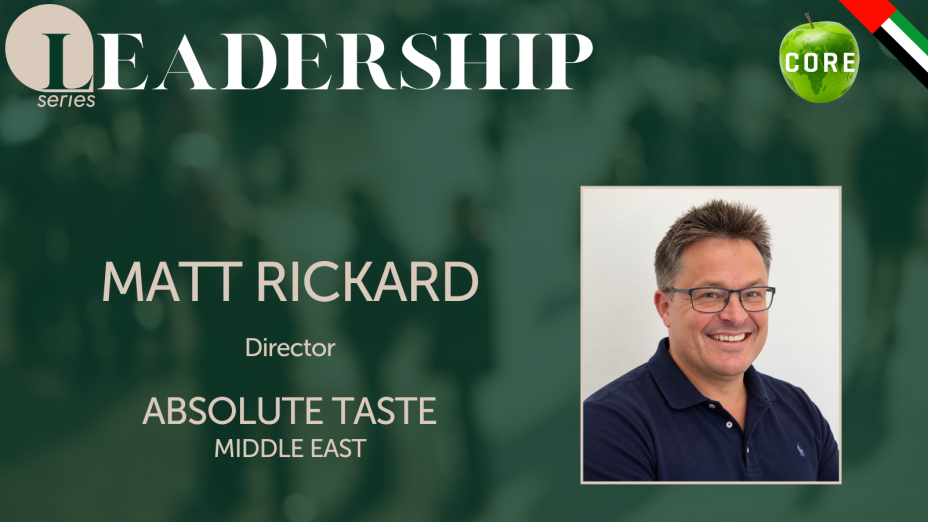
Our Leadership interview series tell the stories of inspiring leaders making an impact across the industry worldwide.
Here, we are speaking to Matt Rickard, Director of Absolute Taste Middle East.
Could you briefly introduce yourself, your role, and the core mission of your organisation within the hospitality landscape?
I'm Matt Rickard, Director of Absolute Taste Middle East, part of the Menu Partners Group, and I've built the business here in the region from the ground up. Within the current landscape, we're focused on growing our footprint across corporate and semi-government organisations, what we'd call B&I from a UK perspective.
We've also got our eye firmly on sport, particularly in Saudi Arabia, given the scale of investment going into sports venues there. Bringing Absolute Taste's DNA and expertise into the sports and entertainment environment across the Middle East is a real opportunity, because the way hospitality is used and expected at venues here isn’t yet where it is in Europe or America. As fans and guest members become more accustomed to a structured hospitality environment with higher expectations, that's exactly where Absolute Taste is positioned to lead.
The other part of my role sits in that same sports and entertainment space, but in the US, where I provide hands-on consulting and advisory to sports and entertainment clients directly. I'm currently working with two clients, at Capital One Arena in Washington, D.C. and at SAP Centre in San Jose, alongside venue owners and team ownership groups, helping them and their incumbent caterers elevate premium hospitality as they invest in their venues, their teams, and new products to meet a growing appetite for premium hospitality across US sports and entertainment.
You've moved between live sport and entertainment venues, luxury hotels, niche kosher catering and now Saudi giga-project catering. What's the thread that actually connects all of it for you?
When I look back across my CV, the thread is consistent: turnarounds, new projects, mobilisations, and businesses that are still being built or that need change and a fresh perspective. Every move I've made, from role to role, has been toward positions that need someone who thrives on delivering something new - someone comfortable starting with a blank sheet of paper and building every part of a business from the ground up: the plans, the vision, the culture, all of it. That's been true from Club Wembley through to Expo 2020, and it's exactly what draws me to the giga-project pipeline in Saudi Arabia today.
I'm not built for an environment that's gone stale or stands still. There's an entrepreneurial streak in me that wants to keep developing a business, continuously - and that, more than any single sector or market, is the real thread connecting live sport, luxury hotels, kosher catering, and now Saudi.
Food Story and Kosher Arabia both asked you to build a business around a very specific, values-led community rather than a mass-market audience. What did that teach you about designing hospitality for a defined group rather than everyone?
I still look back very fondly on my time in the kosher market. What drew me to it initially was the chance to do something different - to build a product and a service in the UK kosher events market that simply wasn't being served properly. It's a fascinating market, because it holds a strong traditional element and, generation to generation, a younger audience that still values that tradition, rooted in the Jewish household, while expecting a genuinely modern hospitality experience.
Blending that tradition with a premium F&B experience was exactly what we set out to do, and it was one of the best learning curves of my career. Working with a defined audience is, in some ways, both easier and more demanding than working with a broad one - you can't hide behind generalities.
We did the same at Kosher Arabia. We built a central production kitchen here in Dubai, largely to produce kosher airline meals - a product that hadn't been meaningfully revisited in years and had traditionally represented a bigger compromise in quality than a standard airline meal. We set out to change that: a kosher meal thought about differently, packaged differently, built with one goal - genuinely lifting the dining experience on board. It worked. The feedback we received globally told us Kosher Arabia was producing the finest kosher meals on aircraft circling the planet, and that's the real lesson: designing for a defined community forces a level of precision and care that a mass-market brief rarely demands.
Compliance is tightening fast - traceability, real-time temperature logging, digitised dashboards are now a condition of winning contracts of any size. Has that changed what you look for in a partner or a client before you take on new work?
Market-wide, we're seeing a much sharper focus on traceability, food safety, and the data behind it - real-time information supporting food safety decisions, exactly as the question describes. That's always been non-negotiable at Absolute Taste. Having worked across the UK and Europe with the business, we were genuinely at the forefront of food safety and how HACCP was applied to our operations, and when I moved into new markets, the GCC first and now the US, the standards we brought with us were usually ahead of what the local market expected from comparable operators. We apply what we call our international standard across every part of the business, everywhere, without exception. So, the tightening the market is seeing now doesn't really register as tightening for us - we were already operating at that bar.
Where it does shape how we choose our clients is at the RFP stage. There have been genuine opportunities in the GCC where the food preparation and delivery model on offer wasn't one we'd accept - long-hold, cook-hot-hold-and-serve setups that a lot of clients here are still built around. In those cases, we've shaped our response around what we actually believe in: proper cook-chill process, fresh preparation on site, rather than compromise the model just to win the work.
You've led teams in live events, luxury hotels and contract catering - businesses with completely different rhythms and pressures. What's the one leadership habit that's travelled with you across all of them?
If there's one trait that's stayed with me across every market and every business, it's a refusal to accept today's standard as good enough for tomorrow. It's the same instinct that's drawn me toward mobilisations, major projects, and mega and giga events throughout my career - a belief that creative problem-solving delivers a genuinely better product and service for the client, not just an adequate one. That's been part of my DNA from the first days of Absolute Taste, inherited from the McLaren Group, through to the giga-project pipeline in Saudi today. In every role I've had, the aim has been to push past industry norms and current trends for the end client, not simply meet them, and often that means bringing ideas in from other markets and other industries into hospitality, rather than only looking sideways at what our direct competitors are doing.
You've been parachuted into new ventures more than once - Food Story, Kosher Arabia, Absolute Taste Middle East. How do you build a team's trust quickly when you're the new name at the top?
I was asked a version of this question fairly recently, and if there's one thing I've learned each time I've walked into a new venture, it's that you can't expect to land in a business and already know everything, however senior you are. The first and most important discipline is to use your eyes and ears: watch, listen, understand the real challenges the operation is facing, and work out who the influencers are in the team. The silent influencers are usually the most important ones. No matter how well prepared you are, or how much information you've been handed beforehand, a business will always throw up things you didn't expect. There are layers to peel back before you can honestly say you understand the business, the team behind it, and the client in front of it, and the operative word is honestly, not pretend to.
On trust specifically: listening goes a long way, as does genuinely understanding the pressure a team is often already under when you arrive. Then identify a handful of quick wins early, real actions that make a visible difference to the business and get them done fast. That's what earns you the right to make the bigger changes later. It's a pattern that's worked for me from Club Wembley and Mandarin Oriental, through Kosher Arabia, to building Absolute Taste Middle East from the ground up.
How do you balance commercial performance against staff wellbeing and retention when you're operating in a market with real workforce pressure?
The way resourcing and people planning works here in the Middle East is structurally different from Europe or the US, and that shapes this answer more than anything else. We're almost entirely non-reliant on part-time, casual, or hourly labour, largely a function of how employee visas work here. Our workforce and headcount are planned and locked well in advance: employees are on long-term contracts, and we provide their accommodation and transport as well as their place of work. That means we don't see the flex and flux you'd traditionally see in a European F&B business.
That changes how we think about the commercial cost of people entirely. In a typical F&B environment, you flex labour to the sales line, staffing up or down as demand moves. Here, we can't do that quickly, so we plan for it: people become much more of a constant cost than a flexing one. Counterintuitively, that actually relieves some of the pressure between commercial performance and staff wellbeing, rather than creating it, because wellbeing is planned into the model from the start rather than something we're trading off against short-term sales swings.
On retention specifically: because our people are on longer-term contracts, we rely on a mix of skilled and less-skilled team members, as any business does, but I put real focus on giving our less-skilled team members the chance to upskill. Wherever possible, we recruit from within, from the bottom of the structure up, and give people training and a genuine path to promotion. That's what keeps team members with us for the long term - knowing the opportunity for growth is real and ongoing, not just a line in an induction pack.
AI and automation are creeping into menu planning, inventory and guest personalisation across the sector. What's genuinely useful there, and what's mostly noise?
For me, the automation side is genuinely the most useful part of this right now. Where we've had software trying to support day-to-day operations, or in some cases were still doing things manually, being able to leverage AI to take the manual, desk-bound work off the team's plate is real value, not hype. It frees people up to be more creative, more thoughtful, or simply to spend more time in the operation rather than behind a screen. I see the clearest efficiencies coming through inventory forecasting - feed these tools better data and we understand our audience more precisely, plan preparation volumes more accurately, and that flows straight through into procurement and the processes around it, receiving, invoicing, all of it. That only gets sharper as we get to know the tools properly.
Where it becomes noise, in my view, is the moment AI and technology start to become the interface to the guest. I believe strongly that premium hospitality should be a more analogue experience, not less - you see guests actively seeking a digital detox, not more screens between them and the service. Making the guest interact with AI, or making a transaction feel tech-heavy, takes the edge off hospitality. In a premium environment, that's exactly the wrong direction.
What's one skill you'd tell someone starting out today they'll need, that you didn't need at their stage of their career?
When I started out, studying from college through to university, the F&B and hospitality world genuinely meant hotels, restaurants, prisons, hospitals, cruise ships, and the army. It was a far narrower industry than it is today, and the roles within it were siloed: you either wanted to be a head or executive chef in the kitchen, or an F&B director in front of house, or director of housekeeping, or director of front office, distinct lanes that rarely crossed.
Now the best leaders I see genuinely understand each other's part of the business. The executive chefs I work with today are just as switched on and influential on the service side of the experience as they are in the kitchen, and equally the Maître D’s and F&B directors I know are well versed in the craft of culinary as much as front of house. So, the one skill I'd point anyone starting out toward now is a genuinely holistic view of the whole operation, not just their own corner of it. I feel fortunate to have built that view myself - I trained as a chef first, then moved into broader management, and some of my earliest opportunities at Absolute Taste had me across facilities management, transport, and brand all at once. That early exposure to every part of a hospitality food business is, without question, the single thing I'd direct anyone joining this career toward today.
What do you want Absolute Taste to be known for in five years?
If I think about Absolute Taste as a whole - here in the Middle East, in the UK and Europe, and with a growing footprint in the US - I see us continuing to develop and evolve as a business, rather than settling into any one shape. The sports and motorsport DNA will always remain core to us, and we'll keep delivering hospitality at major sporting events. As the sports industry itself develops, I believe guests will demand increasingly experiential hospitality, which makes it more demanding for the operator, and that's exactly the space we want to lean into, bringing our experience wherever in the world that need shows up. Here in the Middle East specifically, I think fan experience around the growing sports market is only going to develop further, and that's a genuine opportunity for Absolute Taste.
Our business, particularly in the UK, is already much more diverse than the front end hospitality operator we started as. We're producing for third parties now, building out a central production kitchen model for operators and food businesses that want to outsource production, and as part of the Menu Partners vertical supply chain, I see that becoming a major, growing piece of the business. That pulls us slightly away from being purely a front-end hospitality operator and positions us more as a vertical supplier to the industry at large.
The piece I'm most excited about, though, is taking the experience of the business as a whole and continuing to build our consulting and advisory role to operators, and I see that developing significantly, particularly in the US. Most of the leading sports teams and cities are investing heavily in their venues right now, creating new premium experiences closer to the action, and we have real skill and experience to help those clients, and their incumbent on-site caterers, fast-track and keep developing those experiences for their fans and members. In five years, I want Absolute Taste known for all three of those things at once: sport at its core, genuine production and supply capability behind it, and the advisory credibility to help other operators get there faster.
Looking at your career as a whole, what's the achievement you're proudest of - and why that one, over the more obvious headline roles?
The work we did in the kosher industry, I think, is genuinely the achievement I'm proudest of - across both London with Food Story and Kosher Arabia here in the Middle East.
In London, there was already a private events market doing a good job for its clients: fantastic events in some seriously impressive venues across London and the rest of the UK. But the team we put together at Food Story genuinely pushed the envelope in that market. We were delivering experiential events with fantastic food that just happened to be kosher, and the market reacted quickly - we disrupted it. That wasn't easy. Learning the kosher supply chain for the first time, understanding how kosher law governs which commodities can and can't come together within the same meal, and how that shapes the logistics and operations of delivering an event, created some genuinely hard problems to solve. None of those challenges were new to the industry - we just looked at them differently, and the results were infinitely better for it.
We did the same thing again with Kosher Arabia, this time in the airline meal market, which has its own set of constraints. We developed the product, the menu, and the packaging, with fresh thinking on how kosher airline meals could be prepared, stored and packed properly, and what we ended up putting on aircraft disrupted that niche market too.
I'd pick this over the more obvious headline roles because those experiences weren't about running something that already existed well - they were about walking into a market, working through genuinely hard problems with a team from scratch, and coming out the other side having changed how that corner of the industry actually operates. That's the work I enjoyed most, and it's the work I'm proudest of.
What initially inspired you or sparked your interest in pursuing this career?
It was Delia Smith's cookery books and the late Gary Rhodes on television that first hooked me, probably a combination of the two. I knew this was the industry for me early, as young as eleven or twelve, and I pursued it from the start. My parents were carting me across the UK before I could even drive: to Bournemouth at Christmas, to Marlborough in the summer. Any opportunity going, I took it - Christmas, summer holidays, weekends. Growing up in Cornwall, I was lucky enough to work in some genuinely good restaurants there, starting right at the bottom washing dishes, then waiting tables. I loved the food service and restaurant world from the very first shift, and I've never looked anywhere else since.
How do you stay updated on industry trends, customer expectations, and regulatory changes?
A lot of my work right now is here in the Middle East and in the US, and the trends genuinely aren't the same across those markets, so in whichever market I'm working, I stay close to what's developing and make sure what we're doing is right for that market at its current stage, while also thinking ahead to how things will shift and how we'd need to respond.
Because so much of our work sits in premium hospitality, I look harder at sister and associated industries than I do at direct competitors - private clubs, travel, the high street, even automotive and property - to understand how our customers are experiencing premium elsewhere in their lives, what they're consuming, what they're buying into. Those adjacent industries tell us a lot about our customers, often more than watching our direct competitors does. We've commissioned genuine research into exactly that on client projects, comparing what premium means across industries rather than just within hospitality, because the signals travel. My work with Absolute Taste spans sports and entertainment, B&I, and events, and every one of those touches customers slightly differently, so staying current isn't a single habit, it's a constant cross-referencing exercise.
What's the most important leadership lesson you've learned?
I'm still learning this one every day, if I'm honest. The emotional intelligence piece is something I have to actively work at, understanding that not everybody wants to be led the way I'd want to be led myself, and adapting to that rather than expecting people to adapt to me. That means regularly stepping outside my own comfort zone to lead in a way that actually works for the team, the stakeholders, the colleagues in front of me. I still don't get it right every time.
If I'm honest about my own character, empathy isn't something that comes naturally to me. So, I make a point of keeping someone close, working alongside me, who'll remind me to bring that empathy to the team when it's needed. It's easy to get too busy chasing goals and moving fast and lose sight of what actually matters to the people doing the work, and the leaders I respect most are the ones who never let that happen.
Have you achieved everything you wanted in your career so far?
Absolutely not, and I hope I never do. I've been genuinely lucky: fantastic opportunities, incredible projects, incredible businesses, and some brilliant people along the way. I hope there's plenty more of that still ahead.
What I do wonder is whether there's a point in my career where everything I know about hospitality gets applied to a business that sits slightly outside hospitality itself. I believe there are industries that could genuinely benefit from the skills and the nuance we develop as hospitality leaders. I'm not entirely sure yet what that looks like in practice, but one space I'm watching closely is the flexible workplace world, where the workplace itself effectively becomes a hospitality environment for the people working in it. That's an industry I suspect I'd enjoy, and one I think I'd have a genuine amount to give to.
Author
Date Published: 18th September 2026
