
Leadership series: Anjna Poonia
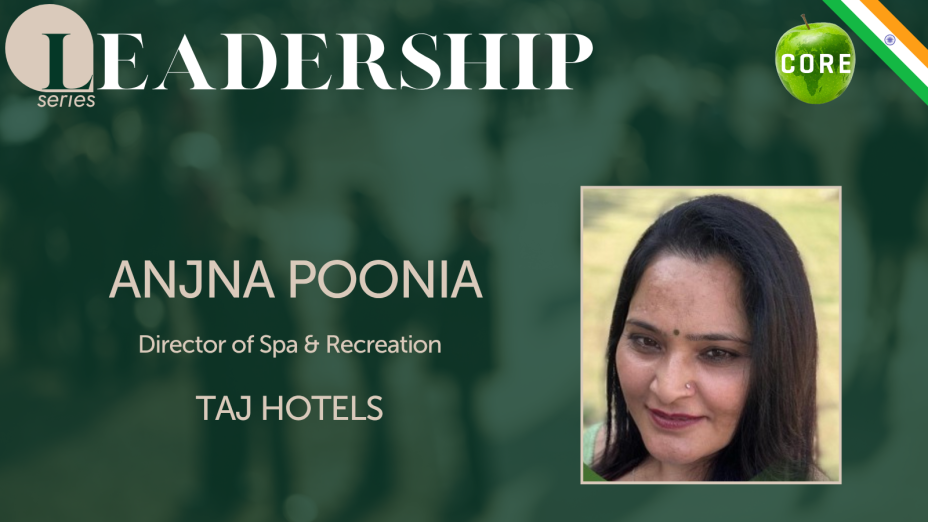
Through our Leadership Series, we share the stories, insights, and journeys of inspiring industry leaders.
In this episode, we are talking to Anjna Poonia, Director of Spa & Recreation at Taj Hotels.
Tell us a little about yourself and your business.
I am Anjna Poonis, hailing originally from India (Rishikesh). I started in hospitality industry in 1999 with India’s destination spa at ANanda In The Himalayas. Currently I work for Taj Hotels and Resorts. Being a Reiki Master Healer, motivator, and spa director with a genuine passion for healing, wellness, and helping people feel their best. I am a good listener who believes that sometimes, being heard and understood can make a real difference in someone’s life. I love spreading positive energy, inspiring others, and helping people find peace, balance, and happiness. My purpose is to make a meaningful difference in people’s lives and communities.
What initially inspired you or sparked your interest in pursuing this career?
It’s an interesting story Initially, I dreamt of becoming a doctor after my schooling because I always wanted to be useful and help people in their stressful living. However, due to family circumstances, I couldn't pursue that dream. Instead of giving up on my desire to help others, I found another path through healing, wellness, and Reiki. This journey led me to become a Healer, motivator, and spa director. Today, helping people makes me feel satisfying physically, emotionally, and spiritually gives me a deep sense of purpose and fulfilment.
What motivates you in your work and what do you find most fulfilling about being a business leader?
Being a business leader allows me to create a caring environment, inspire my team, and help others grow. For me, success is not just about running a business; it is about touching lives, spreading positivity, and making people feel valued and understood. my motivation came from my late. fathers work style he was a self-motivator and a person who was easily reachable and helpful to all his surroundings.
What do you see as the biggest challenges currently facing the landscape where you are and how should/will a business like yours respond?
One of the biggest challenges in the wellness industry today is the stress and busy lifestyle people experience, along with a lack of awareness about holistic healing. Many people overlook their emotional and mental well-being. I believe a business like mine can make a difference by creating a safe, welcoming space where people feel heard, relaxed, and cared for. Through Reiki, wellness therapies, and compassionate listening, I aim to promote holistic well-being, build trust with clients, and make self-care an important part of everyday life.
Thinking about the (current) macro-economic and social environment (cost pressures, labour market, changing customer expectations, sustainability), what shifts do you believe will redefine “success” for our sector in the coming year or years?
In the coming years, success in the wellness and spa industry will depend on understanding changing customer spending habits. With rising living costs, people are becoming more selective about where they spend their money and expect real value for every service. Businesses will need to offer affordable options, personalized experiences, and consistent quality to encourage repeat visits and build customer loyalty. As a spa director I believe that combining genuine care with smart cost management will help my business remain financially sustainable while making wellness accessible to more people. For me, successes mean creating a business that customers trust, value, and choose to return to, even during challenging economic times.
How do you stay updated on industry trends, customer expectations, and regulatory changes?
I stay updated through online courses, wellness webinars, industry articles, social media, and networking with other wellness professionals. I also learn directly from my clients by listening to their feedback and understanding their changing needs. As a Reiki Master Healer and spa director, I continuously explore new wellness practices and keep myself informed through official updates on hygiene, safety, and relevant regulations. I believe continuous learning helps me improve my services and build lasting trust with my clients.
Where do you think the most promising investments should be focused on and/or made on?
"As a Spa Director, my most promising investment focus would be on maximizing our yield per treatment hour through targeted staff cross-training, unlocked by a frictionless digital booking ecosystem. My investment priorities are staff training, improving the skill and spa environment, also expanding personalized services, including Reiki and relaxation therapies. I would also invest in personalized digital marketing, online booking systems and customer loyalty programme to attract new clients and encourage repeat visits. Given rising costs and changing customer spending habits, I believe in investing carefully in services that offer real value, improve customer satisfaction, and generate sustainable returns. My goal is to grow the business while making holistic wellness accessible to more people.
What do you believe will distinguish the leading service providers over the next decade (e.g. niche market, luxury, sustainability, experience-driven, hybrid models…)?
"Over the next decade, leadership in the wellness space won't belong to those with the most expensive marble fixtures, but to those who master hyper-personalized, experience-driven hybrid models.
Today’s consumer views wellness as a necessity, not a luxury, and they want measurable results. The leading providers will distinguish themselves by using data and digital tools to understand a client's stress or energy levels, and then answering that need with deeply intuitive, human-centric therapies like Reiki and somatic relaxation. By positioning the spa as a true sanctuary from digital fatigue—while maintaining a highly efficient, tech-enabled booking and loyalty backend—we create an indispensable wellness partnership with the guest that generic competitors simply cannot match."
If you could influence one thing about the future of hospitality (policy, regulation, social trend, business model…) what would it be, and why?
If I could influence one thing about the future of hospitality, it would be to make wellness and self-care more accessible and affordable for everyone. In today's fast-paced world, stress and emotional exhaustion are common, yet well-being is often overlooked. I would encourage businesses to prioritize mental wellness, compassionate service, employee well-being, and sustainable practices alongside profitability. As a spa director and Reiki Master Healer, I believe hospitality should not only provide comfort but also help people feel cared for, valued, and refreshed. True success is creating experiences that nurture both people and business.
What skills or mindsets do you think will be most important for the next generation of hospitality leaders?
I believe the next generation of hospitality leaders will need empathy, adaptability, strong communication, and emotional intelligence. Understanding customer needs, listening without judgment, and creating personalized experiences will be essential. They must also be comfortable with technology, manage costs wisely, and lead teams with compassion and confidence. For me, the most important mindset is to put people at the heart of the business while remaining open to learning, innovation, and change. A successful leader should create not just satisfied customers, but meaningful experiences that build trust and lasting relationships.
What is or are your biggest career achievement(s)?
One of my biggest career achievements is maintaining zero staff attrition, helping ensure team stability, reduce recruitment and training costs, and maintain consistent service quality. I have also achieved strong guest satisfaction, which has contributed to increased customer loyalty, repeat visits, and revenue growth. These results demonstrate my ability to create a positive workplace while delivering measurable business outcomes. I believe that investing in employee well-being and guest experience directly supports long-term profitability and sustainable business growth.
What’s the most important leadership lesson you’ve learned?
The most important leadership lesson I have learned is that great leadership begins with listening, understanding, and taking action. I make time to listen to my team, address their concerns, recognize their efforts, and create a supportive work environment. I also actively seek guest feedback and take steps to improve their experience. These actions have helped me maintain zero staff attrition, strengthen guest satisfaction, and drive revenue growth. I believe that leading by example, making thoughtful decisions, and treating people with empathy are the keys to building a successful and sustainable business.
Have you achieved everything you wanted in your career so far?
While I am proud of what I have achieved as a spa director, I believe my career journey is still evolving. My future goal is to expand my expertise and contribute more meaningfully to the wellness and hospitality industry. I want to reach more people through healing and wellness, creating meaningful experiences that enhance their well-being. For me, career success means not only growing professionally but also using my knowledge and experience to make a lasting, positive difference in people's lives.
Have there been any hard decisions you had to take as a business leader?
"The hardest decisions I face as a business leader always involve balancing human empathy with fiscal responsibility, particularly when navigating rising operational costs.
At a previous property, I had to make the difficult decision to completely audit and streamline our treatment menu, which meant permanently discontinuing a legacy, product-heavy body wrap that was highly popular with long-time guests but had become financially unsustainable due to a 40% spike in product costs and excessive room cleanup times. Despite initial resistance from both comfortable therapists and disappointed clients, I stood firm on the data and reallocated our investment into intensive staff training for high-margin, low-overhead holistic services like Reiki and specialized relaxation therapies. I led the team through this transition by transparently sharing the business realities, cross training them to elevate their hands-on skills, and educating our clients on the deeper, targeted wellness benefits of the new menu. Ultimately, this decision protected our bottom line by increasing treatment room profit margins by 18%, reducing practitioner burnout, and proving that short-term friction is sometimes necessary to secure sustainable, long-term business growth."
What do you hope your legacy will be both for your organisation and for the hospitality industry more broadly?
I hope my legacy will demonstrate how effective, people-focused leadership translates into tangible business results. As a spa director, I have achieved zero staff attrition by building a supportive workplace, listening to employees, and recognizing their contributions. I have also strengthened guest satisfaction by focusing on personalized service, maintaining quality standards, and responding to customer feedback, contributing to revenue growth and repeat business. These results reinforce my belief that employee retention reduces recruitment costs, consistent service builds customer loyalty, and satisfied guests support long-term profitability. My goal is to continue developing high-performing teams and inspire the hospitality industry to combine measurable business success with genuine care for people and their well-being.
Could you briefly introduce yourself, your role, and the core mission of your organisation within the hospitality landscape?
"I am an experienced Spa Director dedicated to bridging premium holistic wellness with modern operational efficiency, while deeply honouring the philosophy of 'Tajness.' In my role, I drive the strategic growth, financial health, and cultural alignment of the spa, focusing on maximizing treatment room yields, optimizing digital ecosystems, and cultivating high-performing, cross-trained teams. The core mission of our organization within the luxury hospitality landscape is to pioneer authentic wellness experiences that celebrate India's rich heritage, making profound holistic healing accessible to the modern global traveller while delivering sustainable financial returns. We achieve this by embedding heartfelt hospitality into every touchpoint—investing heavily in our therapists' specialized skills, such as Reiki, traditional therapies, and personalized relaxation, which carry exceptionally high margins. By pairing these bespoke guest journeys with a frictionless digital booking and loyalty infrastructure, we protect our operational margins against rising overhead costs, transform our spa into an indispensable sanctuary from digital fatigue, and uphold Taj's legacy of unmatched luxury and trusted care."
What do you see as the most significant challenges and opportunities currently shaping the service industry /sector?
"The most significant challenge currently shaping our sector is the double pressure of rising operational costs and the shift in consumer spending habits toward intentional, results-driven value. With inflation squeezing profit margins, expanding product-heavy treatments is no longer sustainable, forcing us to rethink how we maximize treatment room yields without compromising the ultra-luxury standards expected at a Taj property. Concurrently, consumers are suffering from intense digital fatigue, creating a profound demand for authentic human connection and physical sanctuaries. This challenge directly opens our greatest opportunity: the hyper-personalisation of wellness through a hybrid model that pairs high-tech operational efficiency with high-touch holistic therapies. By investing in low-overhead, high-margin human assets—such as cross-training our therapists in bespoke relaxation rituals—we turn labor into our most profitable asset while providing the deep, measurable stress relief modern travelers crave. When we unlock this high-margin menu using a frictionless, 24/7 digital booking and automated loyalty ecosystem, we seamlessly capture high-intent local search traffic, stabilize our daily revenue against no-shows, and elevate Taj's legacy of trusted hospitality into an indispensable wellness partnership."
Are you expecting consumer expectations to shift this year?
"Yes, I am expecting consumer expectations to shift significantly this year, moving away from standard, passive pampering toward hyper-personalized, results-driven wellness that acts as a direct antidote to modern digital fatigue. Given the global rise in living costs, consumers are spending much more intentionally; they are entirely willing to invest in premium hospitality, but they demand real value, measurable stress relief, and distinct physical sanctuaries.
For us at Taj, this means guest expectations will focus heavily on meaningful customization and seamless convenience. Guests no longer want a generic massage menu—they expect a bespoke therapeutic journey that addresses their specific energy, sleep, or stress levels, which makes investing in high-margin, low-overhead modalities like Reiki and specialized relaxation therapies so vital. Simultaneously, their expectation for luxury now includes frictionless technology. They expect to book effortlessly online 24/7 and engage with intuitive, digital loyalty platforms
How has your leadership philosophy evolved, especially over the past few years of rapid change?
"Over the past few years of rapid change, my leadership philosophy has evolved from a focus on structured operational management to empathetic agility and data-driven people development. Navigating rising costs and shifting consumer habits has proven that a spa's resilience relies entirely on the resilience and adaptability of its team.
Today, I lead through the lens of empowerment and clarity. I believe in investing deeply in my team's growth—such as cross-training therapists in high-margin, low-overhead holistic modalities like Reiki—which not only elevates our service standards but also provides our staff with valuable, specialized career progression. I have learned that transparency is vital; by sharing business realities and the data behind our shift toward digital booking ecosystems and automated loyalty platforms, the team understands why we innovate, rather than just how. Ultimately, my role as a leader within Taj is to model the spirit of 'Tajness' internally fostering a supportive, sanctuary-like environment for my staff so they can authentically extend that exact same deep, unhurried care and healing to our global guests."
What values or behaviours do you consider essential for leadership teams today?
"The essential values and behaviours for leadership teams today centre on empathetic agility, commercial transparency, and an unwavering commitment to operational excellence. In an industry navigating rising overheads and rapidly changing consumer habits, leaders can no longer operate in functional silos; they must possess the agility to pivot strategies quickly while keeping their teams grounded.
First, empathetic agility is crucial because our staff cannot deliver the sincere care of 'Tajness' if they do not experience it from their leaders. This means actively listening to the team and protecting their well-being to prevent burnout, while simultaneously driving performance. Second, commercial transparency is vital; modern leadership teams must break down complex financial data—like the high profit margins of low-overhead holistic services like Reiki versus product-heavy treatments—so therapists and front-of-house staff understand the economic impact of their daily roles. Finally, a commitment to operational excellence through technology ensures that leaders champion systems like automated digital bookings and tiered loyalty platforms, optimizing our revenue per treatment hour. When a leadership team models these behaviours, they create a resilient culture where frontline employees feel valued, informed, and empowered to deliver the world-class, seamless luxury our guests expect."
How do you balance the demands of commercial performance with staff well-being, retention, and culture building?
"Balancing commercial performance with staff well-being is not a zero-sum game; in a luxury service ecosystem like Taj, employee well-being is the primary driver of our financial return. I achieve this balance by aligning our commercial goals with high-margin, low-overhead service models that naturally protect our therapists from physical burnout.
From a menu-engineering standpoint, shifting our investment away from physically punishing, product-heavy treatments toward specialized holistic modalities like Reiki and relaxation therapies inherently balances this scale. These services carry exceptional profit margins because the cost of goods sold is nearly zero, which satisfies our commercial performance metrics. Simultaneously, because these therapies rely on energy work and somatic touch rather than intense, repetitive deep-tissue strain, they safeguard our therapists' physical health and longevity.
What strategies have proven most effective for attracting and growing future talent?
"The most effective strategy for attracting and growing future talent is offering a clear, structured path for skill diversification, framed around high-margin holistic care and modern operational literacy. The new generation of wellness professionals is not just looking for a pay check; they want to join an organization that invests in their long-term professional mastery and honours their well-being.
What advice would you give emerging leaders who want to shape the future of the service industry?
"The best advice to give emerging leaders is to master the hybrid model of leadership, where you become equally obsessed with high-tech operational efficiency and high-touch human empathy. The future of the service industry belongs to those who can look at a profit and loss statement with absolute commercial discipline, while looking at their team and guests with the absolute warmth of 'Tajness.'
First, do not fear technology; use it to automate the mundane so you can elevate the human experience. Implement and master 24/7 digital booking ecosystems, automated marketing, and behaviour-driven loyalty platforms. By removing administrative friction through technology, you protect your business margins against rising costs and give your team the breathing room they need to perform at their best.
Second, recognize that your people are your highest-yielding asset. Instead of relying on product-heavy, inventory-intensive service models, invest heavily in human skill. Cross-train your team in low-overhead, specialized holistic modalities like Reiki and bespoke relaxation therapies. This not only drives incredible profit margins for the business but also protects your staff from physical burnout and builds a sustainable, loyal culture.
Author
Date Published: 4th November 2026
