
Leadership series: Bruno Teixeira
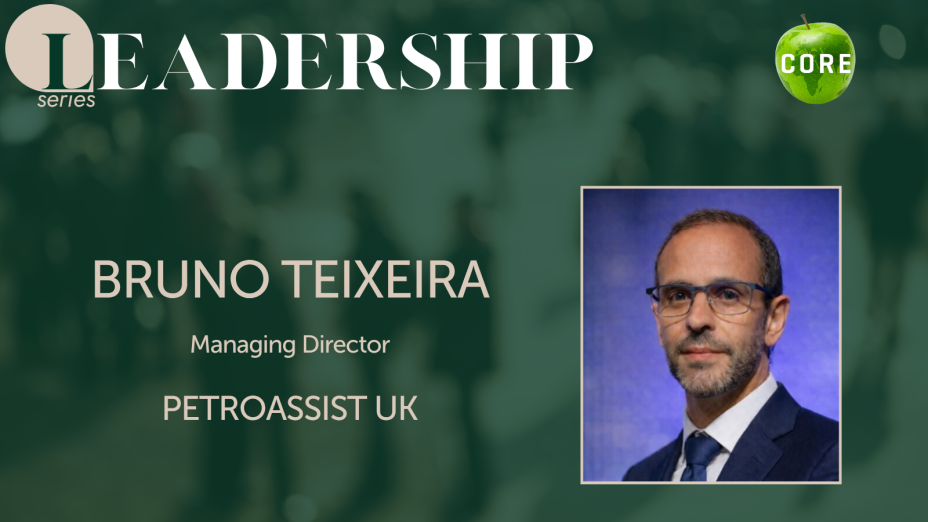
Through our Leadership Series, we share the stories, insights, and journeys of inspiring industry leaders.
Here, we are talking to Bruno Teixeira, Managing Director at Petroassist UK, the leading service provider to the UK & Ireland fuel retailing industry.
You've worked in Portugal, Angola, the Gulf and now the UK and Ireland. How would you introduce yourself today, and what does your role as UK & Ireland Group Managing Director at Petroassist UK involve day to day?
I would describe myself as an international business leader with a strong commercial and financial background and a passion for building, transforming and developing businesses. Throughout my career, I've had the opportunity to work across different industries, countries and cultures, which has shaped both my professional experience and my approach to leadership.
Today, as UK & Ireland Group Managing Director at Petroassist, part of the Petrotec Group, my responsibility is to lead the strategic development and overall performance of our businesses across the region. This involves setting the strategic direction, driving commercial growth, improving operational efficiency, developing our leadership teams, strengthening customer relationships and identifying new opportunities.
We operate in a demanding and highly competitive market, where reliability, customer experience and execution are critical. We have achieved some important milestones, including securing the BP pump maintenance contract and deploying more than 12,000 outdoor payment terminals across the UK.
My focus is on building an organisation that is not only commercially successful but also operationally excellent, with strong management teams and the capabilities to sustain long-term growth. Ultimately, I see my role as creating conditions for people and businesses to perform at their best.
You started your career in banking, at Santander Totta and then BPI. What first drew you to finance, and what made you want to move into running operational businesses?
My career started in banking, where I developed a strong foundation in finance, commercial management, customer relationships and business discipline. Banking is an excellent environment in which to understand how businesses operate, how financial decisions affect performance and, importantly, how to manage risk.
However, I gradually realised that I wanted to be closer to the actual business itself. I was increasingly interested in understanding not just the financial results, but what drives them: the people, the operations, the customers, the strategy and the decisions that ultimately determine performance.
The transition into operational businesses was therefore a natural evolution. I wanted to take the financial and commercial discipline I had developed in banking and apply it in environments where I could have a more direct impact on business development and transformation.
Looking back, I think that combination has been one of my greatest professional advantages. I approach business with a strong financial mindset, but I also understand that sustainable performance comes from getting the operational fundamentals right.
In 2012 you left banking in Portugal for finance director roles in Luanda, first at Ykonsult and then at Mecwide Angola. What prompted that move, and what surprised you most about doing business in Angola?
Moving to Angola in 2012 was a significant turning point in my career. It meant leaving a relatively familiar professional environment in Portugal and stepping into a completely different business landscape.
I was attracted by the opportunity to challenge myself internationally, take on greater responsibility and become involved in businesses operating in a rapidly developing market. It was also an opportunity to broaden my perspective beyond finance and gain a much deeper understanding of business operations.
What surprised me most was the importance of adaptability. In emerging markets, you quickly realise that having a good strategy and a strong business plan is not enough. You need to understand the local environment, build the right relationships, develop trust and be able to make decisions in circumstances where information and resources may not always be readily available.
Angola taught me resilience, resourcefulness and the importance of understanding the context in which you operate. It also reinforced something I still believe today: successful international business is ultimately about people, relationships and the ability to execute.
At CRC Evans (formerly Stanley Oil & Gas) you went from Angola Country Director, to Managing Director across the UAE, Oman and Qatar and then to a global Senior Director role. How did your leadership have to change at each step up?
The progression at CRC Evans was an incredibly important part of my professional development because each step required a different perspective on leadership.
As Country Director, my focus was very much on establishing and developing the business locally, managing customers, building teams and ensuring operational delivery. When I moved into a regional Managing Director position covering the UAE, Oman and Qatar, the complexity increased considerably. I had to move away from being directly involved in every decision and focus more on developing management capability, establishing consistency across different markets and ensuring that the regional businesses were aligned with the wider strategy.
Moving into a global Senior Director position required another shift. At that level, leadership becomes less about managing individual operations and more about influencing, aligning priorities and creating the conditions for different teams and regions to perform together.
One of the biggest lessons I learned was that you cannot lead every organisation in the same way. Different markets, cultures and people require different approaches. However, the fundamentals never change: clarity of direction, accountability, trust and the ability to make decisions.
The higher you progress in an organisation, the more important it becomes to build leaders rather than simply manage people. Your success increasingly depends on the quality of the management teams you develop and the organisation's ability to perform without depending on you for every decision.
Pipeline construction in the desert or West Africa and forecourt services in the UK look very different from the outside. What carried over from your CRC Evans years, and what did you have to unlearn?
Although the industries are quite different, there are many similarities in the fundamentals of running an engineering and service business.
At CRC Evans, I learned the importance of operational discipline, safety, technical expertise and delivering against demanding customer expectations. Working in pipeline construction, often in remote and challenging environments, teaches you that preparation, planning and execution are absolutely critical. You also learn to make decisions under pressure and to understand the financial and operational consequences of those decisions.
A lot of that experience has transferred directly into my current role. Forecourt operations are different in scale and nature, but our customers depend on equipment being available, engineers responding quickly and service partners delivering consistently. Reliability is everything.
What I had to unlearn was the assumption that the same operating model works everywhere. The UK forecourt market is mature, highly competitive and has its own customer expectations, regulatory environment and operational dynamics. You need to understand those differences rather than simply replicate what worked elsewhere.
Ultimately, experience gives you a strong foundation, but the ability to adapt is what makes you effective.
In June 2026 Petrotec acquired Swansea-based Premier Forecourts & Construction, creating a UK operation of more than 200 people with civil engineering and project management capability added. What does that change for customers, and how are you approaching integration while letting Premier keep its own identity?
The acquisition of Premier Forecourts & Construction was a significant strategic milestone for Petrotec Group in the UK. Completed in May 2026, it represents an important step in our ambition to build a broader and more comprehensive service and engineering platform in the market.
For customers, the most important benefit is the breadth of capability we can now offer. Historically, Petroassist has had a strong position in forecourt equipment, maintenance, payment solutions and technical services. Premier brings additional capabilities in civil engineering, construction and project management. Combining these strengths allows us to support customers across a much wider range of requirements and, importantly, gives us the opportunity to develop more integrated solutions.
From an organisational perspective, integration needs to be carefully managed. An acquisition is not simply about combining financial results or structures; it is about bringing together people, cultures, processes and capabilities.
My approach is to identify where we can create synergies and improve efficiency while protecting the strengths that made Premier successful in the first place. I strongly believe that you should not acquire a good business only to dismantle what makes it good.
Premier has its own expertise, reputation, customer relationships and identity. We want to preserve that while giving business access to the scale, resources and international capabilities of Petrotec Group.
Ultimately, the objective is to create more value for customers, employees and shareholders than either business could achieve independently.
Which technologies are you most excited about for forecourts right now (pay-at-pump, remote monitoring, predictive maintenance, AI), and which do you think are overhyped?
I believe we are entering a very interesting period for the forecourt industry. For many years, technology developments were largely focused on improving the equipment itself. Today, the opportunity is much broader: it is about connecting equipment, payments, data and service delivery to create smarter and more efficient operations.
I am particularly interested in the combination of AI, remote monitoring and predictive maintenance. The ability to identify potential failures before they affect customers, understand equipment performance remotely and move from reactive to proactive maintenance can fundamentally change the economics of operating a forecourt.
Our partnership with Titan Cloud is a good example of this direction. By combining AI-driven fuel analytics and maintenance technology with Petroassist's engineering and nationwide service capabilities, we can connect intelligent insights with practical action on the ground.
I also see significant opportunities in payment technology, connected forecourts and the development of alternative energy infrastructure.
Where I am more cautious is around technology that is introduced simply because it is fashionable. AI, for example, is not a strategy in itself. Technology must solve a real problem, deliver measurable value and improve either the customer experience, operational performance or profitability.
I believe the winners in our industry will be those who successfully translate technology into tangible business outcomes.
What values or behaviours do you look for in your leadership team today?
For me, the most important qualities are accountability, integrity, ownership and the ability to deliver results.
I like leadership teams that take responsibility rather than wait for instructions, that are comfortable making decisions and that understand the importance of working collectively towards a common objective. Equally, I value transparency. I would rather have an honest conversation about a problem early than discover it later when it has become significantly more difficult to resolve.
I also believe strongly in leading by example. You cannot expect high standards, commitment and accountability from your teams if you are not prepared to demonstrate those behaviours yourself.
Developing people is equally important to me. I believe one of the most valuable responsibilities of any leader is identifying talent, creating opportunities for people to grow and building strong management teams. You cannot build a sustainable business around one individual or a small number of key people. You need capable leaders at every level who understand the strategy, take ownership and can make the right decisions.
I also value the ability to challenge constructively. I don't believe leadership teams should simply agree with everything. Healthy debate, different perspectives and the willingness to question decisions are essential to making better decisions.
Ultimately, I want people around me who combine commercial awareness with professional judgement, who understand that performance matters but also recognise that people are fundamental to achieving it.
My philosophy is relatively simple: create clarity, give people ownership, invest in their development, establish accountability and allow good people the space to perform.
Looking back across banking, Angola, the Gulf and the UK, what was the turning point that most shaped how you lead today?
If I had to identify one turning point, it would be the decision to leave banking in Portugal in 2012 and move to Angola.
Until that point, my career had followed a relatively conventional path within the financial sector. Moving to Angola completely changed my professional perspective. It took me outside my comfort zone and forced me to develop new skills, adapt to different cultures and take on responsibilities that extended well beyond my original financial background.
That experience opened the door to the wider international career I subsequently developed at CRC Evans and, eventually, to my current responsibilities in the UK and Ireland.
More importantly, it changed the way I think about opportunities and risk. I learned that professional growth rarely happens when you remain within familiar boundaries. Sometimes you need to make decisions without having every answer, accept a degree of uncertainty and trust your ability to learn along the way.
It also taught me that leadership is not about having all the answers. It is about being able to bring people together, establish direction and make decisions even when circumstances are challenging.
I would not have the perspective or experience I have today without making that decision in 2012.
What legacy do you hope to leave, both at Petroassist and in the wider fuel and energy mobility sector?
I would like to be remembered as someone who built businesses, developed people and created opportunities for sustainable growth.
At Petroassist, my ambition is to help build an organisation that is recognised as one of the leading businesses in its industry in the UK and Ireland. Not simply because of its size or financial performance, but because of its reputation, technical capabilities, customer relationships and the quality of its people.
I also want to leave behind a stronger organisation than the one I inherited: one with capable leaders, clear processes, a strong culture of accountability and the ability to continue growing without depending on individual personalities. Developing the next generation of leaders and creating strong management teams is a fundamental part of that ambition.
Looking at the wider industry, I believe we are going through a fundamental transformation. Traditional fuel retail is evolving into a much broader energy and mobility ecosystem, incorporating digital payments, data, convenience, EV charging, hydrogen and new service models.
I would like to contribute to that transformation by helping our industry embrace innovation while maintaining the operational excellence and customer focus that have always been essential to its success.
Ultimately, I believe the greatest legacy a leader can leave is not what they personally achieve, but what the organisation and the people within it are capable of achieving after they move on.
Author
Date Published: 4th November 2026
