
Leadership series: Quinten Knipping
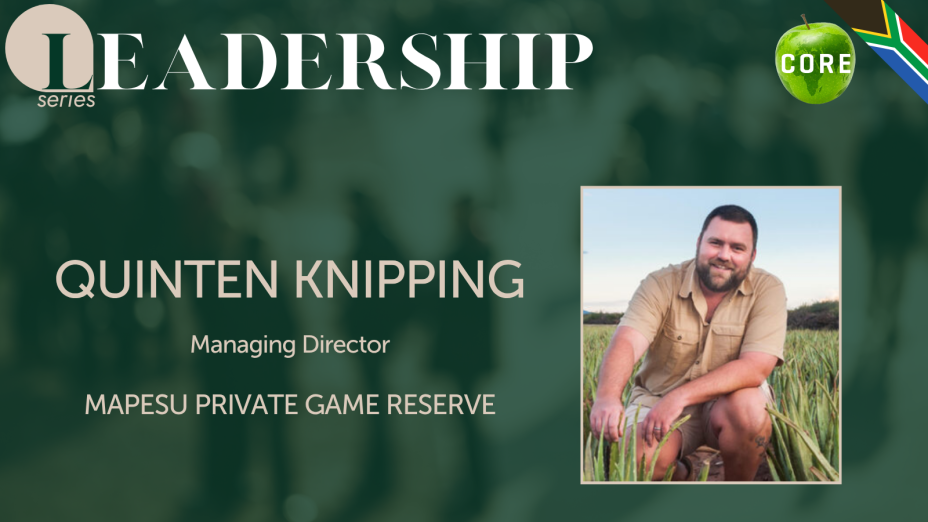
Our Leadership Series of interviews showcase leading figures in the industry through detailed, insightful interviews.
In this episode, we talk to Quinten Knipping, Managing Director of Mapesu Private Game Reserve in northern Limpopo, South Africa.
Tell us a little about yourself and your business.
My name is Quinten Knipping. I was born in Curaçao in the Dutch Caribbean and have lived in Spain, Singapore and South Africa.
As Managing Director of Mapesu Private Game Reserve in northern Limpopo, I bring together two things I care deeply about: building a successful business and protecting nature.
Mapesu borders Mapungubwe National Park and combines accommodation, wildlife experiences and conservation across approximately 12,000 hectares.
What motivates you in your work and what do you find most fulfilling about being a business leader?
I enjoy building something and seeing the results take shape. At Mapesu, that might mean developing a new accommodation offering, seeing a staff member grow into greater responsibility, or introducing an endangered species to the reserve.
The most fulfilling part is when those outcomes support one another: a stronger tourism business creates employment and helps fund conservation, while a healthy reserve gives guests a reason to visit and return.
What do you see as the biggest challenges currently facing the landscape where you are, and how should a business like yours respond?
For a remote hospitality and conservation business, the challenge is that everything needs to work together: access, infrastructure, staff development, wildlife management and a consistent guest experience.
Conservation also carries substantial costs that guests may never see. Our response has to be commercially disciplined while giving people compelling reasons to travel to our region.
Partnerships with neighbouring landowners, conservation organisations and the wider tourism industry are essential, because many of these challenges extend beyond our own boundaries.
What do you believe will distinguish the leading service providers over the next decade?
I believe the strongest businesses will have a clear identity and deliver experiences that guests cannot easily find elsewhere.
At Mapesu, that means going beyond a conventional game drive through experiences such as endangered wildlife tracking, walking safaris, birding and exploring the region’s cultural heritage.
However, an interesting concept only goes so far. Warm service, reliable delivery and attention to detail are what turn a distinctive experience into a business people recommend.
What skills or mindsets do you think will be most important for the next generation of hospitality leaders?
They will need financial understanding, practical problem-solving skills and the ability to work well with people from different backgrounds. Hospitality leaders must understand what happens on the ground, as well as what the accounts are telling them.
Curiosity and adaptability matter enormously. In a business like ours, you can move from a guest concern to a water supply problem to a conservation decision in the same morning. You need to keep learning and remain calm when plans change.
What are your biggest career achievements?
One of my proudest achievements has been helping develop Mapesu into an approximately 12,500-hectare private game reserve, while growing the hospitality business from 16 to 88 beds.
Annual revenue grew by around 600% between 2014 and 2025. Equally meaningful has been the work behind introducing endangered species, including rhinos, and participating in cheetah and wild dog conservation programmes. Those achievements reflect years of work by our staff, shareholders and conservation partners.
What’s the most important leadership lesson you’ve learned?
Taking responsibility does not mean doing everything yourself. As a business grows, trying to remain involved in every decision can become a constraint.
People need clear expectations, the resources to do their jobs and the authority to take ownership.
I have also learned that difficult conversations are usually better handled early. Avoiding an uncomfortable issue rarely makes it easier, whether it concerns performance, finances or the direction of the business.
How do you balance commercial performance with staff well-being, retention and culture building?
I see them as closely connected. A business needs to be financially healthy to provide secure employment, maintain facilities and invest in its people. At the same time, sustained performance depends on staff who feel respected and understand their contribution.
My approach is to set clear standards, pay attention to workloads and address problems directly. In a remote operation, leadership also needs to recognise the practical realities of working and living far from major towns.
How are you embedding meaningful, long-term sustainability into your business?
At Mapesu, conservation is a central reason for the business to exist. Our work includes restoring and managing habitat, supporting endangered species programmes and developing tourism that helps finance those responsibilities.
We work with specialist conservation partners because meaningful outcomes require expertise and cooperation.
For me, sustainability also means building an operation that can meet its financial obligations and support employment over time.
Protecting wildlife requires a business model capable of funding that commitment for decades.
What do you hope your legacy will be, both for your organisation and for hospitality more broadly?
I would like to leave behind a healthier landscape, a capable team and a business that can continue succeeding beyond my own involvement.
I hope Mapesu demonstrates that hospitality can help make conservation economically viable while giving guests a meaningful connection to a place.
Ultimately, the measure of success is whether the wildlife remains protected, people continue benefiting from the business, and the next generation has something worth inheriting.
Author
Date Published: 3rd November 2026
