
Leadership series: Camilla Topham
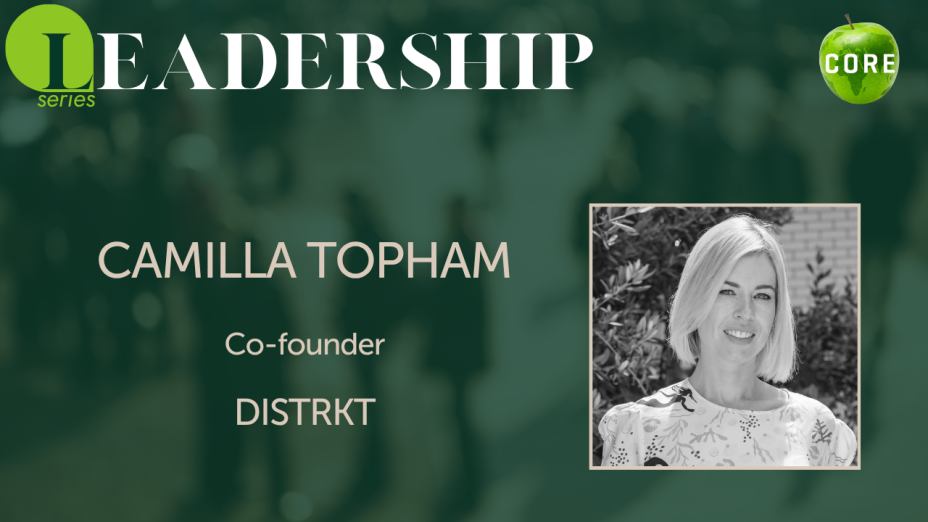
Through our Leadership Series, we highlight outstanding industry leaders through in-depth interviews.
We are here speaking to Camilla Topham, Co-founder of Distrkt.
Tell us a little about yourself and your business.
Distrkt is a hospitality property consultancy, but we are also more than that, we act as a collaborator and conduit between landlords and operators. We work in the main with landlords curating places and developments to shape their food and beverage mix, and with operators on sourcing sites and their expansion strategies. Our existing clients include Shaftesbury Capital, Borough Market Trust and Somerset House, alongside major developments such as the Tribeca scheme at King's Cross and Mayfield in Manchester. In every project, we start with looking at audiences our clients then shape the right mix through our knowledge of and relationships in the hospitality sector.
I trained and qualified as a chartered surveyor, working at several of the big property practices before founding Distrkt 8 years ago. I saw a real disconnect between those corporate businesses and the dynamic, independent operators they were trying to connect with, so Distrkt was born bringing genuine commercial leasing expertise together with a real feel for what makes an operator right for a place and a Landlord. As sole founder, we're the only female-led business in our sector, which has brought its challenges in a male-dominated industry, but it's also our strength – we offer a unique perspective, and a company culture to match. We're proud to be different.
What initially inspired you or sparked your interest in pursuing this career?
My father was a huge influence. He was a hugely successful property developer for most of his working life, and he genuinely cared about creating places which created a positive impact whether through sensitively restoring heritage buildings, shaping public spaces, or bringing in the right occupiers. He was doing placemaking before it was a buzzword in our sector. He'd also started his career in hospitality, working in hotels and was a trained chef and he absolutely loved restaurants and eating out and being in restaurants was a huge feature throughout my life. I followed him into property, qualifying as a chartered surveyor, but I was always drawn to hospitality too and the impact of hospitality on bringing places to life.
What motivates you in your work and what do you find most fulfilling about being a business leader?
Two things. The first is creating places that stand the test of time and become genuine institutions in the way our work at Borough Market, Kingly Court and Somerset House has demonstrated. The second is showing what leadership can look like when it isn't modelled on the traditional, masculine template. Our sector is hugely male-dominated and when I started out there were very few female role models, so like a lot of women I found myself acting more "masculine" and working to their rule book to try and get ahead because that was the only version of leadership on offer. Now I try to do the opposite; I lead in a way that's unapologetically my own, I talk openly with my team about the pressures women specifically face at work, and I try to build a culture where that honesty is normal rather than a liability. Watching other women in the business feel able to do the same is genuinely one of the most fulfilling parts of the job.
What is or are your biggest career achievement(s)?
I've spent my career working on some of the UK's best F&B destinations with the best operators in the industry; Covent Garden, Carnaby and Kingly court and Soho. Our work at Borough Market has helped turn it into one of the most exciting dining destinations in central London rivalling Soho! I’m proud of the positive impact that our projects have left on the world. But honestly, the achievement underneath all of that is far simpler; building Distrkt and still being solvent is my biggest achievement. We've had a bumpy ride, like a lot of businesses in the post-pandemic climate including navigating a split from a business partner and some difficult challenges this past year. Coming through that with a team I'm genuinely proud of; a group of fiercely capable working mothers, is what I'd point to first.
What's the most important leadership lesson you've learned?
Every decision has to be in the best interest of the business. I've made plenty of decisions trying to be nice or kind that were actually at odds with what the business needed. You can still lead fairly but if your decisions consistently avoid what's right for the business, the business can't thrive. Fairness and clarity aren't the same as softness. I would also say that flexibility is important; we are operating in a world that is constantly and quickly evolving and changing, and you have to be prepared to work with the changes rather than resist them.
What do you hope your legacy will be, both for your organisation and for the hospitality industry more broadly?
We're more than a property agency, we see ourselves as a collaborator with our clients and a conduit connecting them with the right operators. We care deeply about the work we do, and we try to champion female-led businesses wherever we can, as we have with Darjeeling Express, Rambutan and Poons. There are still very few female leaders in hospitality, and I'd like that to change and we. I hope our legacy is that we helped create some of the most exciting, diverse food-led destinations in the country from Borough Market to Kingly Court with Tribeca and Mayfield next! And that we did.
On the challenge side, rising costs across the sector are squeezing already thin margins, and weak business confidence, driven by political instability are slowing expansion plans and making operators more cautious about committing to new sites.
But there is real opportunity too. Best in class Landlords are increasingly open to doing good deals with the right operators because they understand the value those operators bring. In a world of screens and growing AI content, the simple act of breaking bread around a table is only going to matter more to us humans as we see real experiences. Landlords recognise how central hospitality is to making places work and that's opening up genuine opportunities for innovative operators which we are seeing right now in London and Manchester.
How do you balance the demands of commercial performance with staff wellbeing, retention, and culture building?
You can't perform commercially if your team is unhappy and burnt out, the two are directly connected. I build a team-led environment rather than one where people compete against each other. Some healthy competition is fine, but what matters more is that if someone's out of action, the baton passes easily. We're a team of mums so we work flexibly around pickups, sick days, sports day whatever comes up. People sometimes assume that flexibility means less commitment. What I've actually learned, both from my own experience of having a child and from watching my team, is the opposite: mums are some of the most capable, multitasking, get-it-done people you'll ever hire. I want them on my team.
Looking back, what has been the most pivotal moment in your career — a turning point that shaped how you lead today?
There have been a couple. Early on, I worked somewhere completely inflexible where I was heavily micromanaged, did long days at a desk in an uninspiring office with very little freedom. When I got pregnant, I knew I'd my baby growing up and be miserable doing it. That was the moment I decided I wanted to lead differently and build a different way of working and while that hasn't come without its challenges, I don't regret it.
The second has been this past year. As a business, we've shed a skin, people have left and coming through that has made me considerably sharper and more resilient. The silver lining is being sole owner of the business allows me to lead more authentically and I'm excited about where we grow from here.
If you could change one policy, trend, or misconception about the sector, what would it be?
A reduction in VAT would give hospitality businesses real breathing space to rebuild margins that have been squeezed for years. The misconception that frustrates me most is that a full, busy restaurant equals a profitable one. It doesn't. A restaurant can be packed every night and still be struggling, because of how much cost the industry has had to absorb in recent years. The Government needs to properly understand the sector and support it accordingly. As a hugely significant contributor to employment and the economy in the UK, it’s been consistently overlooked.
Author
Date Published: 21st July 2026
