
Leadership series: Iteb Abid
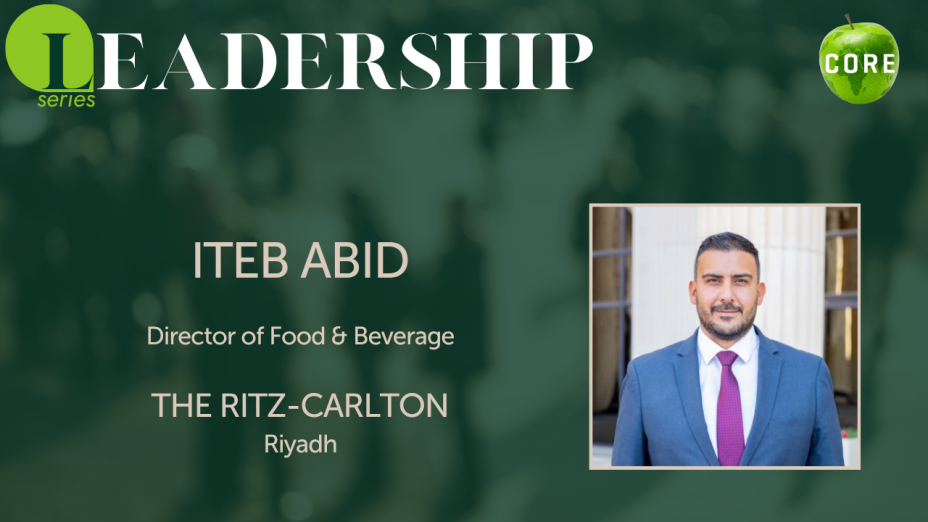
Through our Leadership Series, we highlight outstanding industry leaders through in-depth interviews.
In this interview, we speak to Iteb Abib, Director of Food & Beverage at The Ritz-Carlton, Riyadh
Tell us a little about yourself and your business.
I’m Iteb, Director of Food & Beverage at The Ritz-Carlton, Riyadh. I’ve built my career in luxury hospitality, particularly in Food & Beverage, where I’ve had the opportunity to lead diverse teams and develop restaurants and experiences in highly competitive markets.
For me, Food & Beverage is much more than running restaurants. It is about creating experiences, developing people, building a strong culture, and ultimately delivering sustainable commercial results.
At The Ritz-Carlton, we operate in a segment where expectations are extremely high. Our responsibility is not simply to meet those expectations, but to anticipate them and create experiences that guests will remember.
What motivates you in your work and what do you find most fulfilling about being a business leader?
People are probably my biggest motivation.
Of course, I enjoy seeing strong financial results, successful restaurants and recognition for what we create. But the most fulfilling part is seeing people grow.
When someone joins your team in a junior position and, a few years later, becomes a supervisor, manager or leader, that is a very powerful achievement.
At Marriott International and The Ritz-Carlton, training and development are fundamental to our culture. I believe one of the core responsibilities of any leader is to create the next generation of leaders.
Ultimately, your success shouldn't only be measured by what you personally achieve, but by how many people become better because they worked with you.
What do you see as the most significant challenges and opportunities currently shaping the hospitality sector?
We are operating in a fascinating period, particularly in Saudi Arabia.
The hospitality market is developing incredibly quickly, with new hotels, restaurants, destinations and international brands entering the market. That creates tremendous opportunities, but it also creates one major challenge: talent.
As the industry grows, competition for experienced people becomes stronger. We therefore cannot simply recruit talent; we have to create it.
The other major change is customer expectation. Luxury today is becoming less about formality and more about personalisation, authenticity and memorable experiences.
The businesses that succeed will be those that combine exceptional people, strong concepts, technology and genuine human connection.
How do you balance the demands of commercial performance with staff well-being, retention and culture building?
I don't see these as competing priorities. In hospitality, they are directly connected.
You cannot consistently deliver exceptional financial performance without engaged employees. And you cannot deliver genuine luxury service with a team that doesn't feel valued, trusted and developed.
My approach is therefore to invest heavily in people while maintaining very clear expectations around performance.
Teams need training, recognition and opportunities to grow, but they also need accountability and clear objectives.
When people understand the vision, know what is expected from them and feel that their contribution matters, you create a high-performance culture naturally.
For me, taking care of people isn't separate from the business strategy. It is part of the business strategy.
What innovations, technological, experiential or operational, excite you the most right now?
Technology and AI are obviously going to transform hospitality, particularly behind the scenes.
They can help us understand guest behaviour, forecast demand, optimise revenue, reduce waste and remove repetitive administrative tasks.
But I don't believe technology should replace hospitality.
Luxury hospitality remains fundamentally human.
The real opportunity is using technology to give employees more time to interact with guests. If technology can remove ten administrative tasks from someone's day and allow them to spend that time creating memorable guest experiences, then it has achieved something meaningful.
The winners will not necessarily be the companies with the most technology. They will be the companies that use technology intelligently while protecting the human connection.
What is or are your biggest career achievements?
There are several achievements I'm proud of.
I have had the opportunity to lead Food & Beverage operations delivering exceptional commercial results while maintaining very high luxury service standards. Our teams have achieved outstanding guest satisfaction and quality results, including excellent Forbes and Brand Standard Audit performance, while our restaurants have also received important industry recognition.
Being recognised personally as F&B Icon of the Year in 2025 was also a very special moment.
But I would still say that my greatest achievement is the teams I've helped develop.
Awards are fantastic and financial results are important, but seeing people you recruited or developed becoming successful leaders themselves is something that stays with you throughout your career.
What's the most important leadership lesson you've learned?
That leadership is not about having all the answers.
Earlier in your career, you sometimes believe that becoming a leader means being the person who knows everything and makes every decision.
With experience, you realise that your role is actually to create the environment where other people can succeed.
You set the direction, establish the standards and create accountability, but then you have to trust your people.
I've also learned that consistency matters enormously. Your team watches how you behave when things are going well, but they watch you even more carefully when things go wrong.
For me, leadership is about being demanding on standards while remaining supportive of people.
High standards and genuine care can absolutely coexist.
What advice would you give emerging leaders who want to shape the future of the service industry?
First, stay curious.
Hospitality is changing extremely quickly, so never believe that because something worked five years ago it will automatically work tomorrow.
Second, learn the business beyond your own department. Understand finance, revenue, marketing, digital, operations and, most importantly, people.
Third, don't chase titles too quickly. Chase experiences, responsibilities and great mentors. The title will eventually follow.
And finally, never forget why hospitality exists.
We are in a people business.
You can have an extraordinary building, incredible technology and a beautiful restaurant, but ultimately it is a human being who creates the emotional connection with the guest.
So my advice would be simple: learn the business, stay humble, develop people, protect your standards and never stop evolving.
You went from owning your own restaurant, L'Acropolitain in Nice, to running F&B for one of the biggest Ritz-Carlton properties in the region. Tell us about that journey and what running your own place taught you that a corporate title never could.
Owning L'Acropolitain in Nice was probably one of the most important experiences of my career because it taught me what it really means to be responsible for a business.
When it's your own restaurant, everything matters. You think about the guest experience, of course, but you're also thinking about payroll, purchasing, suppliers, cash flow, marketing, maintenance and whether the restaurant will be full tomorrow.
There is nowhere to hide. Every decision has a consequence.
When I later moved into international luxury hospitality and eventually The Ritz-Carlton, I brought that entrepreneurial mindset with me. Even within a large organisation, I try to think like an owner: Would I spend this money if it were mine? Would I accept this level of quality in my own restaurant? What return are we creating?
The scale is very different today, but that sense of ownership has never left me.
You've worked in Monaco, France, Saudi Arabia... three very different guest cultures and expectations. What's the biggest mental shift you had to make moving between them?
The biggest lesson has been that luxury is not universal in the way it is expressed.
The fundamentals remain the same: recognition, anticipation, attention to detail and genuine care. But what guests value and how they expect hospitality to be delivered can be very different from one market to another.
Working in France and Monaco gave me a strong foundation in European luxury, gastronomy and service. Saudi Arabia taught me to understand luxury through another cultural perspective, where generosity, privacy, family, personalisation and relationships can be extremely important.
So rather than arriving in a new market and saying, "This is how luxury should be done," you first have to listen.
You keep your standards, but you adapt the experience to the culture of your guests.
That ability to adapt without compromising quality is one of the most important skills I've developed.
Saudi Arabia's hospitality sector is expanding fast under Vision 2030. What do you see as the biggest challenge facing F&B leaders in the Kingdom right now, and how are you responding to it?
The speed of development in Saudi Arabia is extraordinary. New hotels, restaurants, destinations and concepts are constantly entering the market.
For me, the biggest challenge created by that growth is talent.
You can build a beautiful hotel relatively quickly. Developing an exceptional hospitality professional takes much longer.
That's why I believe our responsibility as leaders is shifting from simply recruiting talent to creating talent.
Training, mentoring, succession planning and giving young people genuine responsibility have to become part of the business model.
Saudi Arabia has a young population and tremendous ambition around hospitality. If we invest properly in people today, the opportunity to create a new generation of Saudi hospitality leaders is enormous.
Where do you think the smartest F&B investments should be going right now, whether that's in talent, technology, or concept development?
My first investment would always be people.
You can invest millions in a restaurant concept, but without the right people and culture, the guest will eventually feel the difference.
The second area is concept development. Guests have access to exceptional restaurants everywhere now, so simply opening another beautiful venue isn't enough. There needs to be a clear identity, a story and a reason for people to return.
Technology is the third piece. AI, data and automation can help us forecast demand, understand guests, optimise revenue, control costs and reduce administrative work.
But technology should support hospitality, not replace it.
The smartest investment is ultimately the combination of great people, strong concepts and intelligent technology.
Looking back at your career, from opening your own restaurant to leading F&B at The Ritz-Carlton Riyadh, what stands out as your biggest achievement?
There are different achievements I'm proud of for different reasons.
Opening my own restaurant was one because entrepreneurship changes you. Later, being trusted to lead major Food & Beverage operations within The Ritz-Carlton was another important milestone.
At The Ritz-Carlton Riyadh, I'm particularly proud that we've been able to combine strong commercial performance with exceptional luxury standards and industry recognition.
Being personally recognised as F&B Icon of the Year in 2025 was obviously a very special moment as well.
But increasingly, I measure achievement differently.
When I see someone I recruited, trained or mentored being promoted and becoming a strong leader themselves, I'm incredibly proud.
Eventually, the awards sit on a shelf and financial years close. The people you develop become your real legacy.
You went from being your own boss to leading large teams within a global luxury brand. What's the most important leadership lesson that transition taught you?
That you cannot scale yourself.
When you're running a small business, you can personally influence almost everything. At the scale of a major luxury hotel operation, that's impossible.
Your success therefore depends on your ability to create other leaders.
That means setting a very clear vision, establishing standards, developing people and then trusting them to execute.
I've also learned that empowerment doesn't mean lowering expectations. I believe strongly in high standards and accountability, but equally in giving people the support and tools they need to succeed.
My role today isn't to be the hero of every operation. It's to build a team that can perform exceptionally whether I'm standing in the room or not.
That's when you know you've built something sustainable.
Luxury hotel F&B lives or dies on both guest experience and the bottom line. How do you balance commercial performance with staff wellbeing, retention, and culture?
I don't believe you can separate them.
In hospitality, your employees create your product every single day.
If your team isn't engaged, trained or motivated, eventually the guest experience suffers. And once the guest experience suffers, the commercial performance follows.
So developing people isn't simply an HR initiative; it's a business strategy.
At the same time, a strong culture doesn't mean avoiding accountability. People need clear objectives, high standards, feedback, recognition and opportunities to progress.
When you create an environment where employees feel valued but also challenged to perform at their best, you create a very powerful culture.
That's particularly important in luxury hospitality because ultimately happy guests are usually created by engaged employees.
What do you hope your legacy will be, both within The Ritz-Carlton and more broadly for hospitality in Saudi Arabia?
I would like my legacy to be about people and transformation.
Of course, I want to be remembered for successful restaurants, strong financial performance, innovative concepts and exceptional guest experiences.
But I would be even more proud if, ten or fifteen years from now, people who worked with me are running hotels, restaurants and hospitality businesses themselves.
Saudi Arabia is going through one of the most exciting hospitality transformations in the world, and we have an opportunity to help build not only great hotels but also a generation of hospitality leaders.
If I can contribute to that, develop people who eventually become better leaders than I am, and leave every operation stronger than I found it, then I would consider that a meaningful legacy.
For me, leadership isn't about how important you become. It's about how many people you help become important.
Author
Date Published: 21st August 2026
