Leadership series: Jordan Japal
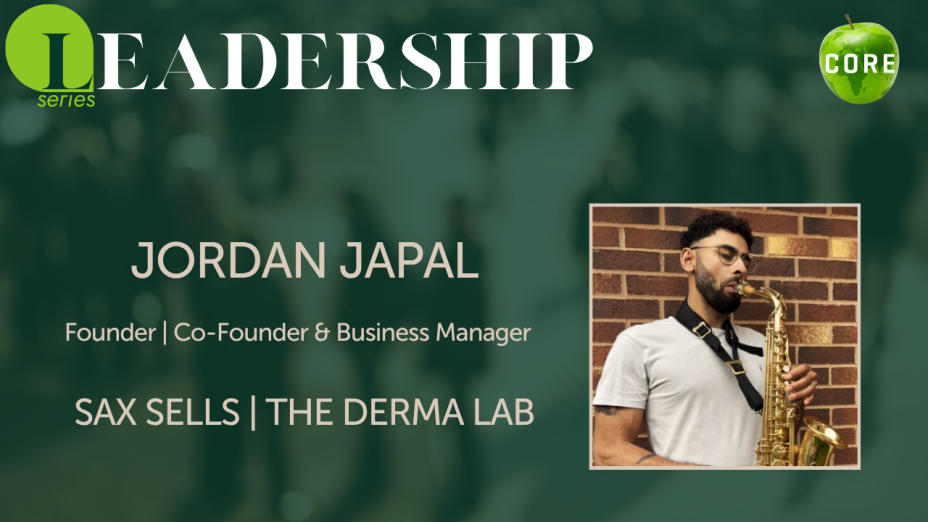
The CORE Leadership Series features in-depth interviews with exceptional and inspiring industry leaders.
In this interview, we are speaking with Jordan Japal, Founder of Sax Sells and Co-founder & Business Manager of The Derma Lab.
Tell us a little about yourself, and how you ended up running Sax Sells while also co-founding The Derma Lab.
I’ve worked in sales within the marketing industry for over a decade, although my original background is in filmmaking. After university, I joined a magazine company and ended up in its advertising department selling ad space. I discovered I was good at sales, particularly the relationship-building side, and my career developed from there.
Sax Sells allows me to combine that experience with the creativity I thought I had left behind. I use direct or lumpy mail, and creative ideas to help businesses stand out. I’m also known as the sax-playing sales guy.
I played saxophone growing up, stopped for a while and then picked it up again after Covid. I started sending prospects videos of me playing, including Adele’s Hello when they had ghosted me. I shared the idea on LinkedIn, people loved it, and I decided to lean into it. It became my personal brand and eventually inspired the rebrand from Fourth Path to Sax Sells.
The Derma Lab began differently. My wife, Elizabeth, is a senior hospital pharmacist and had wanted to train in aesthetics for several years. We made a deal: we would pay for her training, and I would build the website. That meant neither of us had an excuse not to launch it.
Elizabeth brings the clinical expertise, while I handle the website, marketing and business side. The businesses look very different, but both allow me to use different parts of my experience while building something on our own terms.
What was the moment that tipped you from employed to founder?
I had three redundancies within four years, alongside a couple of jobs that weren’t right for me. It was a turbulent period, and it had a significant effect on my anxiety and mental health.
Eventually, I reached a strange point where becoming self-employed almost felt less risky than returning to another full-time role. It also gave me a way to phase myself back into work after taking some time out for my mental health, without immediately taking on the pressure of a full-time job.
The first year was rocky. There wasn’t one dramatic moment where everything suddenly worked. It was more gradual: finding clients, building a reputation and starting to enjoy sales again.
As the business grew, I realised I wasn’t only making it work financially. I was enjoying being busy again and having success while selling in a way that actually felt like me. That was when it stopped feeling like something I was trying and started feeling like the career I wanted to build.
Was there a point where you worried that leaning so heavily on your personality was a risk?
Definitely. I’m naturally someone who wears his heart on his sleeve, but working in sales can make you feel as though you need to sound corporate and tick certain boxes to be taken seriously.
As someone who is mixed race, I’ve sometimes felt that pressure in other parts of my life too, in terms of fitting a certain “image” in certain situations. You become conscious of how you present yourself and whether you fit the version of success that people expect.
When I first leaned into being the sax-playing sales guy, I worried that people wouldn’t understand it or might see it as unprofessional. But the more I did it, the more people got it.
The important thing was that it was never a random gimmick. It began as a genuine method of creative outreach. That became part of my personal brand, which eventually became the Sax Sells brand.
I’ve now had prospects approach me because they’ve seen one of my saxophone videos or a post about a direct-mail campaign. That has shown me that personality can be commercially valuable when it is connected to what you do and how you help people.
What’s the biggest misconception creative businesses have about what gets a prospect to reply?
The biggest misconception is that personalisation means inserting someone’s first name into a message or asking AI to mention something from their LinkedIn profile.
Real personalisation goes much deeper. It means understanding the person, their business and the problem they are likely to be facing. I would rather make a genuine effort with a smaller number of relevant prospects than send thousands of messages that all sound the same.
Timing will always play a part. You can’t control whether somebody needs your help today, but you can make sure they remember you when the time is right.
That’s why creative direct mail is an important part of my done-for-you outreach. I’ve sent mini saxophones for Sax Sells. For my clients, we’ve sent sandpaper to companies experiencing friction in their digital customer journeys. Other examples include fortune cookies, Frankenstein figures and miniature firefighters.
The idea cannot just be creative for the sake of it. It needs to connect to the brand, a relevant problem or, ideally, both.
And a reply isn’t automatically a sale. It is simply the beginning of a conversation, which is what good outreach should be trying to achieve.
What’s the trade-off between staying lean and being able to grow?
Because Sax Sells is currently a one-person business, every client works directly with me. That allows me to get properly under the skin of a small number of businesses and give them a level of care and involvement that would be difficult to maintain with a large client list.
The obvious trade-off is that my capacity is finite. I regularly ask myself whether growth should mean hiring people and becoming an agency, but I’m not convinced that is the right route for me at the moment.
Instead, I’m growing through training and consultancy. I’ve launched The Sax Sells Stand Out Club, a small-group programme for 12 freelancers, solopreneurs and small business owners.
It allows me to teach people how to develop their own positioning, outreach and sales confidence. That includes creative techniques such as direct mail, but also the foundations that many talented business owners have never been taught.
For me, growth means helping more people. It doesn’t automatically mean chasing a huge headcount or trying to build the biggest sales agency possible. My business is growing without needing that structure, and I’m comfortable allowing my definition of growth to develop with it.
What have you learned from co-founding a business with Elizabeth?
The biggest lesson has been recognising the value of complementary skills.
Elizabeth is the clinical expert. She is a senior pharmacist and trained aesthetics practitioner, whereas I bring experience in sales, marketing, websites and business development. We each have areas where the other person’s judgement should carry more weight.
We rarely disagree, but when we do, we know the other person has a genuine reason for their position. We might need to compromise, but it never becomes an argument about who gets their own way.
We’re also aligned on what we want The Derma Lab to become. It doesn’t currently need to be a huge business or replace either of our main careers. It is an additional revenue stream that allows us to experiment, learn and build something together.
Running Sax Sells means I can make most decisions independently. The Derma Lab has taught me more about shared ownership, trusting somebody else’s expertise and removing your ego from decisions. Those are useful leadership lessons in any kind of business.
What will separate the consultants and agencies that remain relevant from those replaced by AI?
AI has made rubbish content and generic outreach incredibly easy to produce at scale. Because everybody can do it, it is becoming even harder to stand out by doing more of the same.
The people who remain relevant will be those who combine technology with the things it cannot replicate particularly well: judgement, empathy, creativity and genuine human relationships.
I use AI regularly. It helps me develop creative campaign ideas and work out whether unusual direct-mail objects are practical to source. I’ve also built a custom GPT around my own training framework to analyse cold calls, discovery calls, pitch calls and follow-ups.
I use it alongside data tools to speed up research and some of the more repetitive parts of prospecting. There are plenty of useful applications when it is operating behind the scenes.
The problem comes when businesses use it to replace their thinking, personality or relationships. The best use of AI is to create more time for the human parts of sales, not to imitate them badly.
What’s your biggest career achievement so far?
The first time Sax Sells reached full client capacity was probably my proudest career moment.
After three redundancies, difficulties with anxiety and a period where I had lost some of my enjoyment of sales, it felt like vindication for choosing the freelance and solopreneur route. I had built something successful while doing sales in a way that felt natural to me.
Building The Derma Lab with Elizabeth is another achievement I’m proud of. We both have separate careers, but we have also created an additional source of income and something we can work on together.
Those achievements have left me feeling more fulfilled than I ever did in full-time employment. That matters more to me than reaching an arbitrary revenue figure.
I don’t see either of them as the peak. I’ve recently launched the training side of Sax Sells, which I want to develop over the coming years. I’m proud of what I’ve built, but I still have plenty of ideas about where it could go next.
What advice would you give someone who’s brilliant at their craft but scared of selling?
The first thing I tell people through my sales training is to forget the stereotype of what sales is supposed to be.
It doesn’t have to mean persuading, pressuring or pushing people. In fact, it shouldn’t mean those things. Good sales is about curiosity, listening, problem-solving and finding the right solution for somebody.
The part that often feels frightening is starting outreach. Many small businesses grow initially through networking, referrals and repeat customers. But if you want to keep growing, you eventually need to step outside that bubble.
You also need to do it consistently. If you wait until the work has dried up before thinking about sales, it is usually too late. You can’t build a healthy pipeline in a week. Regular conversations mean that when you do have capacity, you already have people who know and trust you.
Choose one form of outreach that feels manageable. That could be posting on LinkedIn and following up with connections through friendly messages. You don’t need to pitch them immediately. Just start conversations.
If you feel comfortable picking up the phone, that can be incredibly effective too. The important thing is choosing something you can do consistently, rather than attempting every possible channel for a week and then disappearing.
What do you hope your legacy will be?
I’d like talented people to feel more comfortable and confident selling themselves and their work.
There are so many brilliant people who remain invisible because they don’t know how to sell, or because the stereotypes around sales make them want nothing to do with it.
I want to show people that sales can be human, empathetic, ethical and creative. You don’t need to turn yourself into a boring corporate sales robot to build a successful business.
You can stand out, own your personality and communicate in a way that genuinely feels like you, while still taking sales seriously.
If I help more people gain the confidence to do that and build the businesses they actually want, I’ll feel as though I’ve achieved something worthwhile.
Author
Date Published: 23rd July 2026
