
Leadership series: Martin Ykema
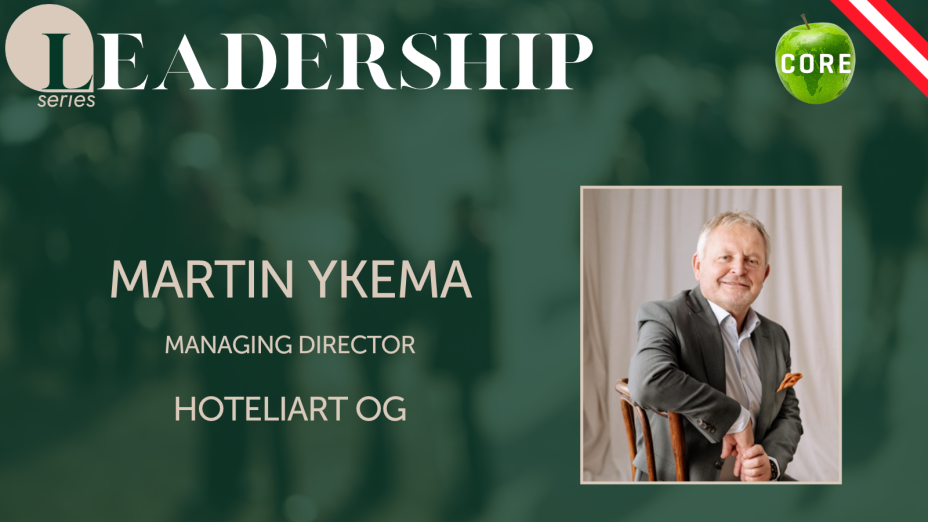
In our leadership series, we present thoughtful interviews with great industry leaders worldwide.
We are here talking to Martin Ykema, Managing Director at Hoteliart OG.
Hoteliart are a specialised boutique hospitality consultancy and advisory firm based in Vienna, Austria. Unlike large operational conglomerates, they operates as a strategic consultancy partner focused on helping hotels and hospitality organizations improve their financial performance, leadership, and workplace culture.
Tell us a little about yourself and your business.
I am Dutch, based in Vienna, and have spent more than 35 years in international hospitality.
My career has taken me from hotel operations in the Netherlands to leading the Novotel in Manhattan, opening Accor’s first hotels in Prague, working on the transformation of ORBIS in Poland, and managing openings and international takeovers with Lindner.
Later, as co-founder and COO, I helped build Vienna House. At HRG Hotels, I worked in the same role on operations and the integration of a large international hotel portfolio of 150 hotels.
Today, I co-owned HOTELIART in Vienna, supporting hotel owners and leadership teams with performance, organizational development and change. This has added an independent perspective to my executive experience. I continue to enjoy taking responsibility for implementation, particularly when a business is growing or integrating hotels and needs to connect its strategic ambitions with daily operations.
What has inspired me to pursue my career?
In a way, it runs in the family. My father was a true entrepreneur who never shied away from starting a new venture, even when he lacked initially the education for it. He owned various businesses, including hair salons, a theatre makeup studio, and a popular bar; beyond his entrepreneurial instinct, he was, above all, a "people person", he was always surrounded by others. Furthermore, an uncle of mine owned a hotel-restaurant, and my brother attended hotel middle-management school, while I was pursuing officer training for my military service at that time. When the opportunity arose to attend the Hotelschool The Hague, one of the leading hotel schools in the world, I seized it immediately. Another lesson I took with me, which has shaped the course of my career, is that one should never be afraid to take the initiative. I have always kept in mind that you are for the largest part in control of your own career, for better or for worse.
What motivates you in your work and what do you find most fulfilling about being a business leader?
I enjoy building and creating something, seeing the evolution and of course positive outcomes and results; that gives me real satisfaction. However, above all I love working with people from all different cultures and countries. And I can say that there are far more things that unite people than divide them; that people, especially in the hospitality industry, have a great deal in common, regardless of their background or the generation to which they belong.
My advisory work the past 2 years has reinforced how much I enjoy being involved in execution. I like developing a strategy, but I want to see what happens afterwards. Working through the difficulties with a team and seeing the results of our decisions is what drives me and keeps me motivated.
How has your leadership philosophy evolved, especially over the past few years of rapid change?
Earlier in my career, I felt I needed to have an answer to almost every question and needed to prove myself ongoing. Over time, after tough lessons learned, I became more comfortable asking questions, listening and giving others the room to find solutions. I have “developed” my eyes and my ears to become my most important “tools”.
Although “change”, like paying taxes or death, is a constant in life, what matters most to me is maintaining a clear focus on established goals, ensuring that people remain motivated and on board. Sometimes you may need to adjust course or shift gears, but that does not mean you should be in a state of constant change mode. Ultimately, that only creates confusion, unrest, and a lack of motivation among your team members….and even yourself. This is not to say, however, that you shouldn’t foster a mindset among your employees that keeps them prepared for potential changes.
The past few years have also reinforced the importance of giving people a clear direction while being honest about uncertainty. You cannot promise that everything will go according to plan, particularly that long-term plans become increasingly obsolete in this rapidly changing environment.
I remain demanding about performance and consistency, but I pay much more attention to whether people have the understanding, right environment and support to deliver what we expect from them.
What’s the most important leadership lesson you’ve learned?
Actually, I have two:
First is Courage. Courage is for me to take the lead, taking initiative, taking direction and making decisions. There is no wait and see if you want to pursue a leadership role. You are in charge and therefore you have the responsibility to move something.
Secondly, is Being Present. It has become something of a personal motto since I have been working in the hospitality industry. Don’t be an “Undercover Boss”.
As your responsibilities grow, your diary quickly fills with meetings, reports and calls. You must make a conscious effort to stay connected with the people running the business every day. To be on the floor in a hotel, or spending at least 200 days per year on the road being visible and with the teams is therefore key.
All my presentations for managers always included the slogan “At least two walks on the floor per day, takes many problems away!!”
What it doesn’t mean is a kind of big brother is watching you; for me, the value lies in observing, listening, asking useful questions and following up. People soon notice whether your interest continues after you have left the hotel or work floor.
What values or behaviors do you consider essential for leadership teams today?
Trust, Respect for People, Culture -and Environment, Integrity and taking Ownership.
Empowerment is a good example. We often ask managers to take ownership, but we need to offer them RESPECT & TRUST, as well as meaningful decision-making authority and space as well. Clear responsibilities with agreed boundaries and access to the right information are essential. I have also had to learn to step back and that I needed to trust others to let them come to results, even in a different way from how I would approach it. Nevertheless, accountability shouldn’t be neglected. Leaders should realize that their decisions have consequences; for people, on performance and on your own self-esteem.
What skills or mindsets do you think will be most important for the next generation of hospitality leaders?
First and above all BE YOURSELF. Despite having a leading role and/or making a fast career, stay who you are. This brought you to the top, so stay authentic.
In this context, I believe future leaders will need consistency between what they say and what they do. Being visible, approachable and following through on commitments. That is how you earn trust. As a leader you lay continuously under the microscope.
Further, increased RESILIENCE is asked for, due to higher competitiveness, more pressure on performance, and increasing complexity of business in general, among others AI, staff & guest expectations, changing ownership, globalisation, ESG.
The next generation will need for sure to understand TECHNOLOGY, data and AI, while recognizing that hospitality still depends on how people make other people feel.
Finally, they will also need the CONFIDENCE to hire people who know more than they do, listen to different views and give their teams real responsibility. Empowerment needs clear expectations, trust and support—and room for people to learn from mistakes.
What is or are your biggest career achievement(s)?
For me, it has never been about the size of the hotels I managed or the number of properties I oversaw; rather, it has been always about creating and contributing to something meaningful and, above all, helping staff members, in particular young managers reach a higher level.
Many of them, whom I had the privilege to mentor and lead in 10+ countries, have gone on to build successful careers and still value the role I played in their development. Naturally, I am also very proud of several milestones: being the first Dutch national to manage the Novotel Manhattan New York, around the turn in the new Millennium; opening the first Accor hotels in the Czech Republic; serving as one of the first Regional Directors for ORBIS in Poland and integrating the company into the Accor network; and last but not least laying the foundation for the creation and successful development of the Vienna House group over the past decade.
And recently, to support the successful OREA group in Czech Republic as a senior advisor, helping to elevate the executive management team and foster a broader focus, specifically on operational excellence and (international) growth.
Across these experiences, I particularly value the people who developed along the way. Staying in contact with former colleagues and seeing them succeed remains very rewarding.
What does the industry need more of (or less) to continue thriving?
I would like to see more attention given to the connection between what leadership teams say and what employees experience. As a leader your words have always impact on stakeholders, particularly your team members. This is heavily underestimated.
Having worked at both hotel and board level, I know how easily a gap can develop. Senior leaders may believe the direction is clear while hotel teams are dealing with competing priorities or waiting for decisions.
We have plenty of opportunities to discuss leadership at conferences and in company communications, and tell each other how the world should be, with most of the time little self-reflection.
The important question is what really happens and what do we do with the lessons we have learned. Do we as leaders really want to change and follow through?
I include myself in that challenge. Regular contact, honest feedback and the willingness to adjust our own behavior are necessary. We should be prepared to examine whether our leadership practices work as well as we think they do.
What advice would you give to emerging leaders who want to shape the future of the service industry?
Learn how hospitality business works, including the jobs you ask other people to do. Understand the numbers and spend time understanding what sits behind them.
Be ambitious and stay curious. Experience is valuable, but it does not mean you have finished learning. I still learn from younger colleagues, particularly when they question something I have taken for granted as it always worked like that. Self-education never stops.
Find people who will challenge you, hold up a mirror, and make it possible for your team to bring you strong feedback. Your reaction will determine whether they do it again.
Finally, take the development of others seriously. Seeing someone become ready for greater responsibility should be a source of pride. I would like to be judged not only by the results achieved, but especially by the strength of the people and organization I leave behind.
Author
Date Published: 29th October 2026
