
Leadership series: Nigel Armitt
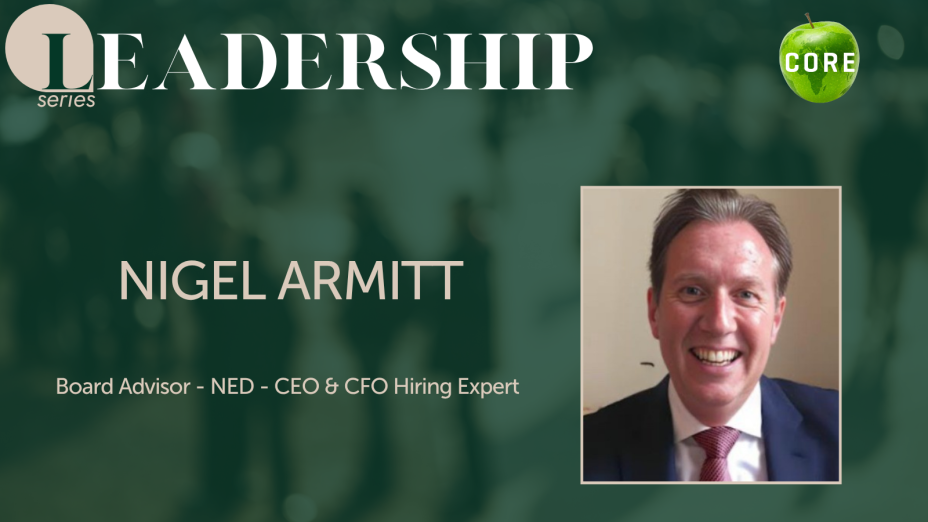
Our Leadership Series puts inspiring industry leaders in the spotlight through exclusive interviews.
In this interview, we speak to Nigel Armitt, Board Advisor - Non-Executive Director - CEO & CFO Hiring Expert.
You've spent over 40 years across finance, leadership and now coaching — from Amnesty International and Cancer Research UK to First Group, the NHS and private equity. What's the thread that ties that whole career together?
Honestly? Rescue missions. If you look at the pattern, I've spent four decades walking into organisations at the exact moment things are wobbling — an international well-known charity with dwindling reserves - only 3 months from having to close its doors. An NHS trust with a large £26M deficit and a large Care home provider - only 3 months from closure. Private equity involved building Board trust and re-locating the London HQ to Cologne plus recruiting a new German Finance team. My unofficial job title should have been "the person you call when the spreadsheet stops making sense and the Board starts looking nervous."
But underneath the numbers, the thread is people. Every single one of those roles — whether I was tripling reserves at Amnesty International or rebuilding trust between Finance and the Board — came down to the same question: how do you get talented, well-meaning people to make better decisions under pressure? Finance was just my entry point into that conversation. I spent 35-plus years using a calculator to build trust, which sounds like a strange sentence, but it's true. Numbers don't lie, and once people trust the numbers, they start trusting each other — and that's when organisations turn around. Coaching, it turns out, was the natural next chapter, not a departure from it.
What made you move from being a career CFO to founding First Success Coach?
There's a particular moment every turnaround CFO knows well: you've fixed the balance sheet, the crisis has passed, and you're sitting in a room with a brilliant senior leader who is unsure about their next career move — not because they lack talent, but because nobody ever taught them how to walk into an interview or a boardroom and actually show what they're capable of. I watched this happen repeatedly, across sectors, across seniority levels — genuinely excellent people getting passed over not for lack of ability, but for lack of preparation and self-belief.
Besides seeing bad C-suite recruitment where the new incumbent does not last more than 6 months. Result > recruit again – management time wasted, staff morale suffers, disruption across the organisation and additional costs.
At some point I realised I'd spent my whole career solving the "is this organisation financially sound" problem, and there was an equally important, equally under-served problem sitting right next to it: "is this person set up to succeed?" First Success Coach was born out of that gap. I didn't want to just fix balance sheets anymore — I wanted to help fix careers, one interview, one Board appointment, one hard conversation at a time. Turns out, thirty-five years of navigating boardrooms under pressure is exactly the toolkit you need to help someone else walk into theirs with confidence instead of fear.
You're an FCMA and an NLP Master Practitioner, and you hold a red belt in Choi Kwang Do. How do those different disciplines feed into how you coach and advise people today?
People usually assume the FCMA and the martial art belong in entirely different corners of my life — one's a filing cabinet; the other's a punch bag. Honestly, they're the same discipline wearing different outfits.
The FCMA gave me rigour — the ability to look at a mass of numbers and find the one insight that matters, instead of drowning in noise. NLP gave me the language layer on top of that: how people think, what's really being communicated underneath the words in a stressful negotiation or a nervous interview answer. And Choi Kwang Do — which, for anyone picturing me doing flying kicks in a boardroom, it's not that dramatic — teaches you something the other two disciplines can't: how to stay calm and centred when someone or something is coming directly at you. Turns out that's an extraordinarily useful skill whether you're facing a physical opponent or a Board member who's just asked you the one question you were hoping wouldn't come up.
Put the three together and you get my actual coaching philosophy: read the situation clearly (FCMA), understand what's really going on beneath the surface (NLP), and respond from a place of composure rather than panic (Choi Kwang Do). It's not a bad blueprint for a job interview. It's not a bad blueprint for life, either.
Looking back across Amnesty International, Cancer Research UK, Leonard Cheshire and beyond, what's the achievement you're proudest of, and why that one?
Amnesty International would be the greatest achievement — and not by a small margin.
Most organisations are complicated in one dimension. Amnesty International was complicated in about eleven. We're talking about an organisation operating across 69 legal entities in 66 countries — every one of them with its own local laws, its own financial reporting quirks, its own culture, and its own very strong opinions about how things should be done. If you've ever tried to get three departments in one building to agree on a shared spreadsheet, multiply that by 66 countries and add a global human rights mission on top. That was the job.
And here's the part that still makes me laugh a little when I look back: I had six weeks.
Six weeks after walking through the door as Amnesty's first-ever CFO — a role that had never existed before, which meant there was no playbook, no predecessor's notes in a drawer somewhere, no "here's how we usually do this" — I found myself on a plane to Johannesburg, South Africa, for Amnesty's Global Assembly. Not to observe. Not to quietly get my bearings in the corner. I was there to stand up in front of representatives from dozens of countries and answer the question every single one of them had come with: why does this role exist now, and what is about to change for us?
There is a very particular kind of pressure in that room. It isn't the pressure of one difficult stakeholder — it's the pressure of every country's Treasurer, each with their own specific, pointed, entirely legitimate question, all looking at the newest person in the building as though I was about to hand them the answer to a puzzle I'd only just started assembling myself. No pressure, then. Just the financial future of a global human rights organisation, explained by the person who'd had six weeks to learn where the coffee machine was.
What got me through that room wasn't having every answer polished and ready — nobody could have, six weeks in. It was being honest about what I did know, clear about what I was there to build, and calm enough under the barrage of questions to listen to what each Treasurer was really asking beneath the surface. That skill — staying composed and genuinely present when the pressure is at its highest — turned out to be the real foundation of everything that followed at Amnesty: the reserves we rebuilt, the financial sustainability we established, the trust we earned back country by country.
If there's a lesson in it, it's this: you don't need to have all the answers to walk confidently into the room that scares you most. You need to be honest, prepared, and steady — and the credibility builds from there. More than almost anything else in four decades of finance and leadership, rescuing Amnesty International is my proudest moment.
5You've said the first thing you do in a turnaround is start with the cash. Talk us through what actually happens in the first 30 days of a new assignment.
Cash doesn't lie. Everything else in an organisation — the strategy deck, the five-year plan, the confident tone in the last Board meeting minutes — can be dressed up. Cash cannot. It's either in the bank or it isn't, and that's why it's the first thing I look at, usually before I've even worked out where the good coffee machine is.
In the first 30 days, I'm essentially running a forensic audit disguised as an onboarding process. Week one is about building a genuine, granular cash flow picture — not the version in the last board pack, the actual version, reconciled against bank statements and real payment runs. Deep dive into Debtors and cash collections - looking for what immediate improvements can be made to Increase Cash Collections. There are always some short-term quick wins which can be implemented and often involves re-training the Credit Control team in using best practice and efficient processes. Week two, I'm meeting every function head individually, and I'm listening far more than I'm talking, because the story people tell you about "why the numbers look like this" is often more revealing than the numbers themselves. By week three, I've usually found at least one uncomfortable surprise — a supplier dispute nobody flagged, a reserve that's been quietly borrowed against, an ineffective Credit Control team that needs to refocus and ongoing mentoring or a forecast built on an assumption that stopped being true eighteen months ago.
Week four is about stabilising: short-term cash actions, an honest conversation with the Board about where things really stand, and a Detailed 12 monthly Cash Forecast (regularly revised) plus less detailed Year 2 Cash Forecast that isn't built on hope. My biggest wins resulting in future increased cash inflows has consistently always been in the Credit Control department.
The pattern holds whether it's a growing startup or large human rights organisation — the scale changes, the sequence doesn't. Get the cash truth first. Everything else you build sits on top of that foundation to ensure future financial sustainability is delivered.
Boards are increasingly using experienced interims as strategic bridges rather than caretakers. What's changed in what a board expects from an interim CFO or FD compared with five or ten years ago?
Ten years ago, an interim CFO was essentially a highly-paid pause button — someone competent enough to keep the lights on and the numbers accurate until the "real" permanent hire could be found. Caretaker is exactly the right word. You weren't expected to make any major changes; you were expected to not break anything / “keep the seat warm” until a new permanent CFO arrived.
That's changed almost completely. Boards now bring interims in precisely because they want and expect change to be delivered— fast diagnosis, difficult conversations that a permanent hire might be too politically cautious to have in month one, and a level of independent, unvarnished challenge that's much easier to deliver when you know you're not building a twenty-year career at that organisation. An interim is not worried about being liked he/she is more concerned with delivery. Not worried about telling the Board the truth even if it reflects on previous management or Boards. That's a genuinely different value proposition, and Boards increasingly know it. Therefore, the Daily rate for an experienced interim CFO has increased because they are expected to have more skills and a wider experience than ten years ago. Having multi sector experience across many different organisations is an advantage.
The other shift is scope. A decade ago, "interim CFO" meant finance. Today, Boards routinely want that same person to execute a major change programme, implement a new IT system, providing governance challenge, helping shape succession planning for the permanent role, and acting as a strategic translator between the executive team and the Board — which, frankly, is most of what I do now as an advisor, minus the interim title. The caretaker has become the strategist. It's a much better use of the experience, and a much more interesting way to spend a Tuesday.
What's the biggest misconception people bring into executive coaching or interview preparation that you have to unlearn with them first?
That the goal is to sound impressive. It isn't. The goal is to be understood, and those two things are far more often at odds than people expect.
Senior professionals walk in carrying decades of jargon, acronyms, and internal shorthand that made perfect sense inside their last organisation and mean almost nothing to the panel or Board sitting across from them. They think competence is demonstrated through complexity. It's demonstrated through clarity — the ability to take something genuinely complicated and make it land in one clean sentence. That's a much harder skill than sounding clever, and it's the first thing I have to strip away before we can build anything real underneath it.
The second misconception, close behind: that preparation means memorising the "right" answer. It doesn't — it means being so comfortable with your own story that you can answer whatever gets asked, rather than the question you rehearsed for. Nobody has ever been caught out by being too authentic.
Many people have been caught out reciting something that stopped sounding like them somewhere around the third read-through.
You coach C-suite executives across sectors. What do senior finance leaders get wrong most often when they're trying to move from a technical role into genuine board-level influence?
They keep answering the question that was asked five minutes ago, in a meeting that's now three questions further on. Technical excellence trains you to be precise, thorough, and complete — brilliant qualities for producing a set of accounts, genuinely unhelpful qualities in a Boardroom, where the Chair has now moved on and just wants to know whether the number is a problem or not. I have watched enormously capable finance leaders lose the room not because their answer was wrong, but because it was three minutes long when the moment needed fifteen seconds.
The deeper issue underneath that is confidence about judgement, not just numbers. A great finance leader can tell you precisely what happened. A Board-level finance leader tells you what it means and what to do about it — and is willing to have an opinion out loud, in the room, even when it might be wrong. That's a genuine mindset shift: from "I report the facts accurately" to "I'm accountable for the interpretation, not just the arithmetic." The technical skill got them into the room. Owning their judgement is what keeps them there.
What's the one question a trustee or NED should always be asking the finance team, but often isn't?
"What are we assuming, and what happens if we're wrong?"
Boards are remarkably good at scrutinising the numbers that are presented to them, and remarkably bad at interrogating the assumptions sitting underneath those numbers — the ones nobody says out loud because they've quietly become "just how we do the forecast." I've sat in Board meetings picking through water-damage insurance disputes and reserve write-offs that, if you traced them back far enough, all started with an assumption nobody had stress-tested in years.
A good trustee doesn't need to be a qualified accountant to ask this question well. They just need the discipline to keep asking "and what if that's not true?" until the finance team either produces a genuinely solid answer or discovers, in front of everyone, that they hadn't tested it either. That single habit — gently, persistently questioning the assumption rather than the arithmetic — reveals more genuine risk than any amount of scrutinising decimal points ever will.
Should CFOs and finance leaders see AI as a threat to their function or as their biggest opportunity, and why?
Opportunity — but only for the people willing to use it rather than quietly hope it goes away. AI is extremely good at the part of finance that used to consume entire teams' weeks: reconciliations, scenario modelling, trend analysis across huge datasets, first-draft forecasting. That's not a threat to the CFO role — that's the CFO role finally being freed from its most repetitive, least valuable work. Finance is about providing information to aid management in decision making.
The genuine risk isn't AI replacing finance leaders. It's finance leaders who refuse to engage with it becoming slower, less relevant, and quietly outpaced by peers who've learned to use it as a force multiplier — building faster scenario models, spotting risk earlier, freeing up real time for the judgement-and-influence work that Boards actually need from you. I'd put it plainly: the CFOs who thrive over the next decade won't be the ones who know finance best. They'll be the ones who know finance best and have made AI part of how they think, not something they delegate to the team downstairs or to the IT Department to implement and never look at it themselves.
Employers are now using AI in recruitment too. What should candidates be doing differently to stand out from an AI-screened process?
Stop writing your CV for a human and start understanding that a machine reads it first. That's not cynical — it's just the current reality, and pretending otherwise costs good candidates interviews they should have got. AI screening tools are pattern-matching against the language in the job description, so vague achievements ("responsible for finance function") get filtered out in favour of specific, quantified ones ("delivered £18M in annualised savings, doubled bank facilities") — precision beats politeness every time in an automated first pass.
But — and this is the part people miss — once you're through that first filter and in front of an actual human, the AI-optimised CV can start to feel oddly flat, out of place and interchangeable, because everyone's been optimising for the same algorithm. That's exactly where genuine, specific storytelling becomes your differentiator again: the actual moment under pressure, the real decision you made, the human detail that a keyword-matching system was never built to notice. My advice is blunt: write the CV for the machine, then walk into the interview and be unmistakably, specifically your human self. The algorithm gets you through the door. It's still a person who decides whether to shake your hand at the end. Remember 70 % interviewers make their decision after first 5 minutes.
What's the biggest financial risk charity boards are underestimating at the moment?
Reserve erosion disguised as resilience. Too many charity boards look at a healthy-looking reserve figure on the balance sheet and quietly relax, without asking the harder question: is that reserve actually liquid, adequate for our real risk exposure, and growing in line with our obligations — or is it just a number that hasn't been stress-tested since it was set? I've sat inside more than one organisation where a reserve that looked comfortable on paper turned out to be nowhere near sufficient once you modelled a genuine shock — a major funder pulling back, an insurance dispute dragging on for years, a building issue nobody budgeted for.
The other underestimated risk is dependency concentration — too much reliance on too few funding sources, at exactly the moment when government and institutional funding across the sector is under real pressure. Boards that are still treating their reserve policy and funding mix as "set and forget" governance items, rather than something to actively pressure-test every year, are the ones most likely to be blindsided. Financial resilience in the charity sector isn't a number you calculate once. It's a discipline you must keep proving each year.
Author
Date Published: 15th September 2026
