
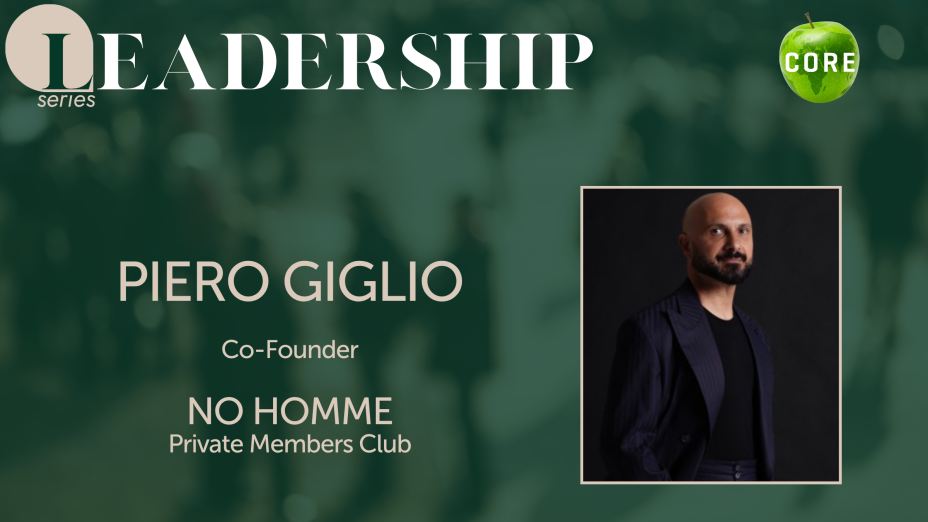
Leadership series: Piero Giglio
A life in hospitality: from operations to entrepreneurship
Our leadership interview series documents the perspectives of influential and inspiring industry figures.
Here, we are speaking to Piero Giglio, Co-Founder at No Homme | Private Members' Club and F&B Consultant.
Tell us a little about yourself and your professional journey.
I’m an Italian hospitality executive and entrepreneur with more than 25 years of international experience across luxury hospitality, fine dining, F&B operations and concept development.
My career has taken me through the USA, London and the UAE, with Dubai becoming the centre of much of my professional journey. I started on the operational side of hospitality, working directly on the floor and learning the business from the guest experience upwards. Those early years gave me a foundation that I still consider fundamental today: understanding people, service, discipline, attention to detail and the realities of running an operation day to day.
My career then developed through luxury hotels and internationally recognised restaurant groups, including Ago at the Shore Club in Miami, Jumeirah Beach Hotel, BiCE, Wolfgang Puck and Qbara, before moving into group-level operational leadership with Orange Hospitality, overseeing concepts including Il Borro Tuscan Bistro and Alici.
Over time, my responsibilities expanded beyond operations into P&L management, business strategy, brand positioning, concept development, partnerships, team building and the creation of new hospitality businesses.
That progression eventually led me into entrepreneurship. As Founder and Managing Director of Mine Lifestyle Management, I worked across concepts including Chic Nonna and L’Amo Bistro del Mare, combining operational leadership with advisory, brand strategy and concept development.
Today, as Co-Founder and Managing Director of No Homme, my perspective has expanded further into private members’ clubs, luxury lifestyle, strategic partnerships, member experience and long-term business development.
What defines my journey is that I have experienced hospitality from many different perspectives—from working on the floor to running restaurants, leading multi-venue operations, developing concepts and ultimately becoming an entrepreneur. It allows me to understand both sides of the business: the experience we create for the customer and the commercial strategy required to make that experience successful and sustainable.
What initially attracted you to hospitality?
For me, hospitality has always been about people. Over the years, however, it has become much more than a profession. It has become a way of life and, in many ways, part of my personality.
I genuinely enjoy what I do every day: meeting people, creating experiences, building relationships, developing ideas and dealing with the challenges that naturally come with this industry. When you truly enjoy what you do, you reach a point where it no longer feels like work.
After more than 25 years in international hospitality, that passion is still there. The industry has changed enormously throughout my career, but my curiosity and enjoyment of hospitality have never disappeared. I think that is ultimately what keeps you motivated and constantly looking towards what comes next.
How has your progression from operations to entrepreneurship changed the way you look at hospitality?
It has given me a much broader perspective.
When you come through operations, your focus is naturally on execution: the customer, the team, service standards, revenue, costs and making sure the business performs consistently every day.
Becoming an entrepreneur changes the questions you ask. You start much earlier in the process: Is this the right concept? Is it right for this particular market? Who is the customer? What investment is required? What is the revenue model? How should the brand be positioned? And, importantly, how do we make the business commercially sustainable?
Through Mine Lifestyle Management, I became increasingly involved with investors, venue owners and culinary teams, developing concepts around specific markets and customer expectations while also looking at feasibility, operational planning and brand strategy.
That experience made me a more complete hospitality professional. Today, I can look at a project creatively, operationally and commercially, rather than seeing those elements in isolation.
You have worked with established brands and also created your own concepts. What have you learned from both experiences?
Established brands teach you the importance of standards, structure and consistency. When you work within strong hospitality organisations, you understand that the customer should experience the brand consistently, regardless of what is happening behind the scenes.
Creating your own concepts is very different because you begin with a blank page. You have to understand the market, identify the opportunity and then build the identity, positioning, product and experience around it.
Developing concepts such as Chic Nonna and L’Amo Bistro del Mare reinforced something I strongly believe: you cannot simply take something that works in one market and assume it will work somewhere else. A concept has to make sense for its location, its market and, most importantly, its customer.
Concept development, brand strategy, understanding market trends and listening to customer behaviour have therefore become increasingly important parts of my work throughout my career.
What motivates you most as a business leader?
Creating something and seeing it become successful remains one of my greatest motivations.
There is a particular satisfaction in starting with an idea, understanding the opportunity, developing the concept, bringing together the right people and eventually seeing customers experience something that previously existed only as a vision.
People development is equally important to me. Throughout my career, I have built and led teams across different cultures, markets and types of hospitality businesses. My experience has shown me how important strong teams and a guest-focused performance culture are to the success of a hospitality business.
Seeing someone you have worked with develop into a stronger professional or leader is extremely rewarding. For me, creating businesses and developing people go hand in hand.
What is the most important leadership lesson you have learned?
Never lose touch with the operation.
As your career develops, it is easy to become increasingly involved in meetings, strategy, budgets and presentations. All of those things are necessary, but hospitality ultimately happens in front of the customer.
I have managed P&Ls, budgets, procurement, financial reporting, commercial strategy and operational systems, but numbers only tell part of the story. You also need to understand what is actually happening inside the business.
That is why I still believe in talking to employees, observing the operation, listening to customers and paying attention to the details.
Leadership also has to be consistent. You cannot ask your team for discipline, accountability, passion and high standards if they don’t see those same qualities demonstrated by you.
What separates a successful hospitality concept from an average one?
First and foremost, a clear identity.
There are many beautiful restaurants, hotels and hospitality concepts today. Design is important, but design alone is no longer enough.
You need to understand exactly who your customer is and why they should choose you. The food, service, design, atmosphere, music, pricing, positioning and communication all need to support the same story.
Then comes consistency. Creativity may bring a customer through the door for the first time; consistency is what brings them back.
And finally, the economics have to work. One of the most important lessons I have learned from moving from operator to entrepreneur is that a great hospitality idea must also be a sustainable business. Creativity and commercial discipline need to work together.
How important are relationships in luxury hospitality?
They are fundamental.
My career has always been built around relationships—with guests, teams, investors, owners, developers, landlords, brands and business partners.
At the luxury end of hospitality, particularly when dealing with high-net-worth and ultra-high-net-worth customers, relationships are built over time. People remember how you make them feel, whether you understand their preferences and, most importantly, whether they trust you. Relationship building and personalised experiences are also important elements of my current work.
The same principle applies commercially. Successful hospitality projects depend on alignment between operators, investors, developers and other stakeholders. A creative concept may be the starting point, but the relationships and commercial structure behind it have to be equally strong.
What changes are you seeing in luxury hospitality and F&B?
Customers today are far more sophisticated, informed and internationally exposed.
People travel more, experience hospitality around the world and can immediately see what is happening in Dubai, London, Milan, Paris, Monaco, New York or Miami. As a result, expectations have become significantly higher.
Luxury is becoming less about formality and more about personalisation, relevance, access, convenience and memorable experiences.
I also believe hospitality is moving beyond its traditional boundaries. Restaurants, wellness, private members’ clubs, business, lifestyle and real estate are becoming increasingly interconnected.
Technology and AI will play an important role, particularly around customer data, personalisation, revenue management and operational efficiency. But technology should enhance hospitality rather than replace its human element. Ultimately, people still want to be recognised, understood and genuinely looked after.
What do you look for when building a team?
Attitude, character and the willingness to learn.
Technical experience is important, particularly for senior or specialist positions, but many technical skills can be developed. Genuine hospitality is much harder to teach.
I look for people who care about the customer, respect their colleagues, take responsibility and genuinely want to improve.
Throughout my career, I have led cross-functional teams across restaurant management, culinary operations, customer service and support functions. One thing I have learned is that the strongest operation is not necessarily the one with the greatest collection of individual talent. It is the one where talented people understand how to work together towards the same objective.
As a leader, part of your responsibility is to create that environment and give people the opportunity to grow within it.
What has been one of the biggest changes in your career?
Moving from being primarily an operator to becoming a business builder.
Earlier in my career, my responsibility was largely to make an existing operation perform at the highest possible level. Today, I look at hospitality much further upstream.
Before the doors even open, I am thinking about feasibility, market positioning, investment, customer profile, revenue model, operational structure and scalability.
That doesn’t mean I have moved away from operations. In fact, I believe my operational background makes me stronger in development. When I look at a concept on paper, I naturally start thinking about how it will actually function once the doors open.
Experience has taught me that many operational problems can be avoided by making the right strategic decisions at the very beginning.
What excites you most about the future of hospitality?
The opportunity to keep creating.
Hospitality is evolving rapidly. It is no longer simply about opening another restaurant or hotel. We are seeing hospitality become part of much broader ecosystems involving lifestyle, wellness, private membership, branded residences, real estate and investment.
That creates significant opportunities for people and businesses that understand both hospitality operations and business development.
What particularly interests me is identifying what customers in a specific market will need next and then creating something around that need.
For me, innovation in hospitality doesn’t necessarily mean reinventing everything. Sometimes it means understanding a customer better than anyone else and creating an experience that feels exactly right for that market and that moment.
What advice would you give the next generation of hospitality leaders?
Learn the operation before becoming too focused on titles.
Spend time on the floor. Understand your customers and understand your P&L. Learn how kitchens, bars and service teams operate, how people behave under pressure and what really makes customers return.
Then broaden your knowledge. Learn about finance, development, marketing, real estate, investment and brand strategy. The more you understand about the complete business, the better leader you will become.
And if you have the opportunity, work internationally. Moving between different countries, markets and cultures teaches you adaptability in a way that is very difficult to learn from a textbook.
Most importantly, remain curious and never assume you know everything. Hospitality never stops changing, and neither should you.
How would you describe the next chapter of your professional journey?
For me, the next chapter is about bringing everything I have learned together while continuing to enjoy what I do every day. That enjoyment is still what keeps me going and gives me the drive to continue creating, developing and exploring new opportunities.
After more than 25 years of operating, developing and building hospitality businesses, I want to use that experience at a strategic level while remaining closely connected to the product, the customer and the operation.
What excites me particularly is creating concepts for different markets and different customer needs. Expectations are changing quickly, trends continue to evolve, and I believe hospitality constantly needs fresh thinking. I enjoy identifying what may be missing in a particular market and developing a concept that responds to that opportunity in a relevant, distinctive and commercially sustainable way.
Whether through entrepreneurship, a leading international hospitality organisation or an investment and development platform, I want to continue working with ambitious people and businesses where I can contribute not only operationally, but also through concept creation, brand development and growth.
At this stage of my career, it isn’t simply about the next position. I still genuinely enjoy this industry every day, and that is what keeps my drive alive: the opportunity to keep creating, to keep evolving and to use everything I have learned to develop hospitality experiences that respond to how people want to live, dine and connect—today and in the future.
Author
Date Published: 16th September 2026
