
Leadership series: Dr. Carlo Scavone
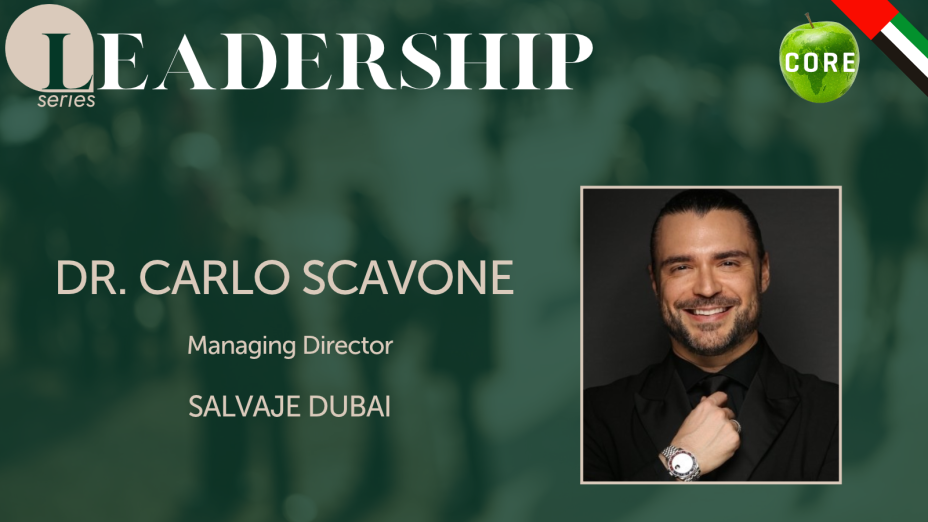
Discover exceptional industry leaders through in-depth interviews in our Leadership series.
In this episode, we speak to Dr. Carlo Scavone, Managing Director at Salvaje Dubai
Tell us a little about yourself and your business.
I’m Carlo Scavone, an Italian hospitality executive based in Dubai, with more than twenty years in luxury hotels and food & beverage. I’ve worked with brands such as Armani Hotels, Kempinski, St. Regis, Marriott as executive, and I’ve led restaurant and lounge operations as a Managing Director. Alongside operations, I hold a Ph.D. in Law, which shapes how I approach contracts, franchise models and partnerships. In my career I’ve always runned any business with an independent advisory mindset: I help developers, hotel groups and brands create, position and protect F&B and lifestyle concepts, and I connect them with the right partners across the Gulf and Europe.
What initially inspired you or sparked your interest in pursuing this career?
I grew up in Italy, where the table is the centre of family life and hospitality is a form of respect. Very early I understood that a great meal or a great stay is not about the product alone, but about how you make a person feel. That intuition turned into a career when I saw that luxury hospitality combines everything I enjoy: people, culture, languages, aesthetics and business. It’s one of the few industries where you can be an entrepreneur, a diplomat and a storyteller in the same day.
What motivates you in your work and what do you find most fulfilling about being a business leader?
What motivates me is building things that last: a concept that becomes a destination, a team that grows into leaders, a partnership that works for both sides years later. The most fulfilling part is seeing people I hired or mentored take on bigger roles. Commercially, I enjoy the moment when a vision on paper becomes a full dining room. That combination of human growth and tangible results is what keeps me going.
What do you see as the biggest challenges currently facing the landscape where you are and how should/will a business like yours respond?
In Dubai the biggest challenge is the pace of supply. New hotels, restaurants and members’ clubs open every month, so concepts age quickly and guests are spoiled for choice. Talent is the second challenge: everyone competes for the same experienced people. The answer is differentiation with substance: clear identity, consistent service and a real reason to return, not only a beautiful opening. In my advisory work I push clients to invest in the concept’s DNA and in their teams before investing in décor and launch parties.
Thinking about the (current) macro-economic and social environment (cost pressures, labour market, changing customer expectations, sustainability), what shifts do you believe will redefine “success” for our sector in the coming year or years?
Success will be measured less by top-line revenue and more by quality of revenue: margins, repeat guests and lifetime value. Cost pressures mean operators must be disciplined with menus, staffing models and supply chains. Guests increasingly want meaning, not just luxury: wellbeing, provenance, authenticity. Retention of staff will become a performance indicator in its own right. And sustainability will move from a marketing slide to a licence to operate, especially with investors and developers.
How do you stay updated on industry trends, customer expectations, and regulatory changes?
First, by being in the field: I visit openings, talk with chefs, GMs, owners and guests, and travel regularly between the Gulf and Europe. Second, through my network of UHNW clients, who are often the first to adopt new habits. Third, through reading: trade press, investor reports and regulatory updates. My legal background helps here, because I read contracts and regulations with a critical eye. Speaking six languages also lets me follow markets directly, not through translations.
Where do you think the most promising investments should be focused on and/or made on?
I see three areas. People: training, leadership development and career paths, because they are the product. Wellbeing and longevity: guests want food and experiences that make them feel better, and I’m personally developing a longevity-driven F&B concept inspired by the ultracentenary habits. And data: understanding guests well enough to personalise service without being intrusive. Bricks and décor still matter, but they are no longer what makes a venue win.
What do you believe will distinguish the leading service providers over the next decade (e.g. niche market, luxury, sustainability, experience-driven, hybrid models…)?
The leaders will be the ones with a strong, honest identity. I believe in experience-driven luxury that is quiet rather than loud: impeccable product, deep personalisation and genuine warmth. Niche concepts with a clear story will outperform generic “luxury”. Hybrid models will grow too, combining dining, wellness, culture and membership in one ecosystem. Sustainability will be expected rather than rewarded. Ultimately, the winners will be those who remember the guest’s name and preferences, not those with the biggest chandelier.
If you could influence one thing about the future of hospitality (policy, regulation, social trend, business model…) what would it be, and why?
I would change how the industry values its people. Hospitality is still seen by many as a temporary job rather than a profession, and that perception drives away talent. I would push for structured career paths, fair compensation and recognised qualifications, as we see in law or medicine. If we treat hospitality as a serious profession, we attract serious people, and guests feel the difference immediately.
What skills or mindsets do you think will be most important for the next generation of hospitality leaders?
Emotional intelligence first: reading guests and teams is still the core of the job. Then commercial literacy, because a leader must understand a P&L as well as a service sequence. Cultural agility matters enormously in places like Dubai, where a single dining room can host twenty nationalities. Finally, curiosity and humility: the willingness to keep learning, to adopt technology where it helps, and to stay close to the floor even with a big title.
What is or are your biggest career achievement(s)?
I’m proud of having contributed to some of the most iconic hospitality brands in the region, and shivting always between operations and leading a business as Managing Director. Completing a Ph.D. in Law while building a hospitality career is another achievement I value, because it gave me a rare combination of skills. But what I’m proudest of is the people: colleagues who started with me in junior roles and are now managers and directors.
What’s the most important leadership lesson you’ve learned?
That clarity is a form of kindness. Teams don’t fail because they lack talent; they fail because they don’t know exactly what is expected, why it matters and how success is measured. When I set clear standards and explain the reason behind them, people rise to the challenge. When I’m vague, even excellent people struggle.
Have you achieved everything you wanted in your career so far?
No, and I hope I never feel that I have. I’ve achieved a lot of what I set out to do as an operator, but the next chapter is about creating and owning concepts, not only running them. I want to build brands that carry an Italian sense of hospitality and wellbeing, and that can travel from Dubai to other markets.
How do you prioritise tasks when everything feels like a priority?
I ask three questions: what affects the guest today, what affects the team’s safety or wellbeing, and what affects the business long term. Guest and team come first, then the strategic items that nobody else can move. Everything else I delegate, schedule or drop. I also protect a short block of time every day for thinking, because without it you only react.
Have there been any hard decisions you had to take as a business leader?
Yes. The hardest are always about people: restructuring a team, letting someone go, or walking away from a partnership that no longer reflected my values. I’ve also had to defend the interests of a business firmly, even when it was uncomfortable. What I’ve learned is to decide on facts, document everything, communicate with respect, and never postpone a decision that you already know is necessary.
What do you hope your legacy will be both for your organisation and for the hospitality industry more broadly?
For the organisations I work with, I’d like to leave concepts and teams that keep performing long after I’ve moved on. For the industry, I’d like to be remembered as someone who brought a bridge between Italian culture and the Gulf, and between creativity and governance: proof that a hospitality leader can be both a host and a rigorous business mind.
Could you briefly introduce yourself, your role, and the core mission of your organisation within the hospitality landscape?
I’m Carlo Scavone, a senior hospitality and F&B executive and independent advisor based in Dubai. My role is to sit between owners, developers and brands, and to turn an idea into a concept that performs. The mission of my practice is simple: create hospitality experiences with a strong identity, protect them with solid agreements, and make them commercially sustainable. I bring together operational experience, legal rigour and a network built over twenty years in the region.
What do you see as the most significant challenges and opportunities currently shaping the service industry/sector?
The challenges are rising costs, talent shortages and saturation in key cities. The opportunities are just as big. Wellbeing and longevity are reshaping what guests want to eat and how they want to live. High-net-worth travellers are looking for privacy and discretion more than display. And there is huge room for well-structured brand partnerships, licensing and franchising, especially for European brands entering the Gulf. Those who combine creativity with discipline will capture these opportunities.
Are you expecting consumer expectations to shift this year?
Yes, and the shift is already visible. Guests want healthier menus without sacrificing pleasure, more transparency about ingredients and sourcing, and service that feels personal rather than scripted. They also judge value more carefully: they will still spend generously, but only where the experience justifies it. Quiet luxury, wellness and authenticity are the three words I hear most from clients.
How has your leadership philosophy evolved, especially over the past few years of rapid change?
Early in my career I led mostly through standards and control. Over time, and especially after the pandemic, I moved toward leading through trust and context. I share more of the “why”, I give teams more ownership, and I accept that the best ideas often come from the floor. I’ve also become more entrepreneurial: I think like an owner, not just an operator, and I expect my teams to do the same.
What values or behaviours do you consider essential for leadership teams today?
Integrity above everything: say what you do and do what you say. Then accountability, respect and consistency. Guests notice when standards change depending on who is on shift, and teams notice when leaders apply rules unevenly. I also value discretion, which is essential in luxury, and a genuine openness to diversity, because our teams and guests come from everywhere.
How do you balance the demands of commercial performance with staff well-being, retention, and culture building?
I don’t see them as opposites. A tired, unmotivated team cannot deliver luxury service, so well-being is a commercial decision. In practice, that means realistic staffing levels, fair rotas, recognition and clear growth paths. At the same time, I’m transparent with teams about the numbers, because people work better when they understand how their effort affects the business. Culture is built in small daily gestures, not in annual events.
What strategies have proven most effective for attracting and growing future talent?
Three things work consistently. A strong brand and a leader people want to learn from. Visible career progression, where people can see colleagues being promoted from within. And mentoring: I invest personal time in coaching high-potential people, including on the business side, such as costs, contracts and negotiation. In a city like Dubai, offering growth and a sense of belonging is often more powerful than a slightly higher salary.
What innovations, technological, experiential, or operational, excite you the most right now?
On the technology side, AI and data tools that help us know guests better and forecast demand, so we can personalise service and reduce waste. On the experience side, the fusion of gastronomy and longevity: food designed to be both delicious and good for you. Operationally, I’m excited by leaner, smarter concepts that deliver Michelin-level quality with simpler structures. Technology should free up time for hospitality, never replace it.
Sustainability is a growing priority. How are you embedding meaningful, long-term sustainability practices into your business?
I start from the concept, not from the communication. When I design an F&B concept, I look at sourcing, seasonality, menu engineering and waste from day one, because that is where real impact happens. Shorter supply chains, smarter portioning and fewer but better products reduce both waste and cost. I also see social sustainability as part of the picture: fair working conditions and long-term careers are as important as the carbon footprint.
Looking back, what has been the most pivotal moment in your career, a turning point that shaped how you lead today?
The move from being a senior operator inside international brands to becoming a Managing Director. Inside a big brand, you have systems and support. When you lead a business directly, every decision has your name on it: payroll, partners, contracts, reputation. That responsibility made me more decisive, more careful with commitments, and much more respectful of what owners and investors go through.
What’s a lesson you learned that still influences your decisions?
Put it in writing. Good relationships matter enormously in hospitality, especially in the Gulf, but clear agreements protect those relationships rather than threaten them. My legal training taught me this in theory; experience taught me in practice. Today, whether it’s a partnership, a hire or a mandate, I make sure expectations, responsibilities and rewards are defined from the start.
Who or what has had a major influence on your approach to leadership?
My Italian upbringing first: the idea that welcoming someone into your home is a duty and an honour. Then the great hotel brands I worked for, which taught me that excellence is a system, not an accident. And the many general managers and owners I’ve worked alongside, from whom I learned both what to do and, sometimes, what never to do. Living in the Gulf for so long has also shaped me: here, respect, patience and relationships are central to doing business.
What does the industry need more of (or less) to continue thriving?
More investment in people and more original concepts with a real point of view. More collaboration between operators, developers and education institutions. Less copy-paste: too many venues look and taste the same because they chase the same trends. And less short-termism: concepts are often judged after six months, when real hospitality brands are built over years.
If you could change one policy, trend, or misconception about the sector, what would it be?
The misconception that hospitality is “easy” or low-skilled. Running a luxury hotel or restaurant requires finance, law, psychology, logistics, design and leadership, often all before lunch. If parents, schools and investors understood how complex and rewarding this profession is, we would attract more talent and more serious capital.
What is your long-term vision for your organisation, and what legacy would you like to leave within the industry?
My vision is to build a portfolio of hospitality and lifestyle concepts that carry an Italian soul, with a strong focus on wellbeing and longevity, developed in Dubai and exported to other markets. Through my advisory work, I want to keep helping owners and brands enter the Gulf the right way. The legacy I’d like to leave is a generation of leaders who see hospitality as a profession of excellence, and concepts that still feel relevant ten years after opening.
What advice would you give emerging leaders who want to shape the future of the service industry?
Stay close to the guest and close to the numbers; the best leaders understand both. Learn languages and cultures, because hospitality is a global conversation. Build your reputation slowly and protect it fiercely, since in this industry everyone knows everyone. Be curious beyond hospitality: law, finance, design and technology will make you a better leader. And never forget that behind every great experience there is a team that felt valued.
Author
Date Published: 28th October 2026
