
Leadership series: Younis Al Dawoodi
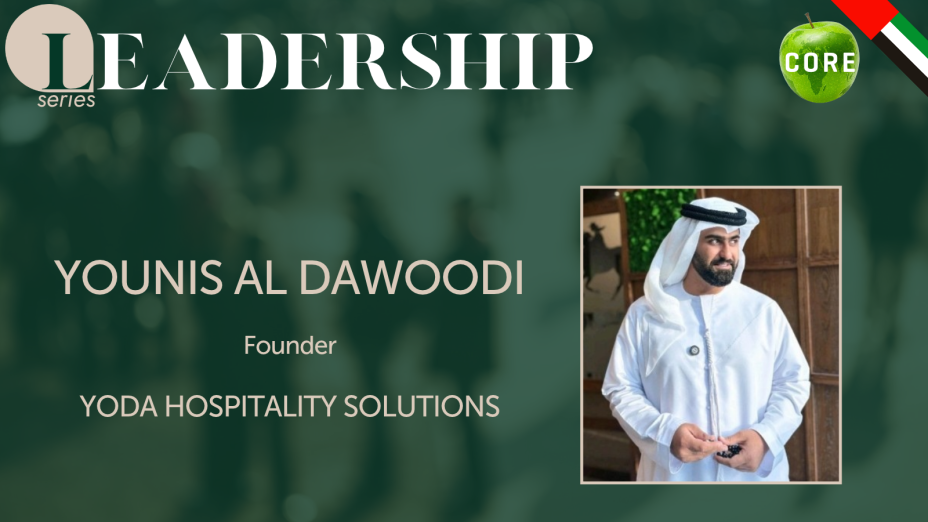
In our Leadership series, we bring inspiring industry leadership to life through in-depth interviews.
We are here interviewing Younis Al Dawoodi, Founder at YODA Hospitality Solutions
Younis Al Dawoodi is an Emirati hospitality and real estate executive from Ras Al Khaimah, and the founder of YODA Hospitality Solutions, a hospitality development and investment advisory firm. He has spent nearly two decades in hotel operations, asset management, business development and real estate advisory. In that time he has advised on over US$19 billion of hotel and real estate assets, across more than 45 projects and 5,500 keys in the GCC, Africa and Europe.
He is also founder and principal of AMD Real Estate in Ras Al Khaimah, and founder of the Noor Foundation, a humanitarian nonprofit supporting neurorehabilitation across the Middle East and Africa. He was named among the Global 200 Inspirational Leaders in 2023. He holds a postgraduate business qualification from IBMI Berlin and a bachelor’s degree from the University of New Hampshire.
Tell us a little about yourself and your business.
I’m an Emirati from Ras Al Khaimah, and I’ve spent close to twenty years on both sides of the hospitality table. I’ve worked in hotel operations, managed assets for owners, originated management agreements for operators and advised investors on real estate. That mix shapes how I work: I know what keeps a general manager awake at night and what keeps an owner awake at night, and they are rarely the same thing.
Today I run YODA Hospitality Solutions, a hospitality development and investment advisory company based in Ras Al Khaimah. We take owners and investors from idea to opening and beyond: concept and feasibility, operator selection, agreement structuring, technical services and asset management. I also lead AMD Real Estate, which focuses on land and commercial real estate in the emirate.
Alongside the business, I founded the Noor Foundation, a neurorehabilitation nonprofit.
What initially inspired you or sparked your interest in pursuing this career?
It started with family. I grew up in the Bin Dawoodi family in Ras Al Khaimah, where business was part of everyday conversation and building something of your own was expected. As the eldest in a large family, I also learned early what it means to be responsible for other people every single day.
Hospitality brought those two things together. It’s a serious business with serious capital behind it, yet every part of it comes down to taking care of people: guests, teams, owners and communities.
The second spark was watching what hospitality did for my country. In the UAE, hotels bring airlines, events, jobs, investment and international attention with them. I wanted to be part of that, especially at home in Ras Al Khaimah.
What do you see as the biggest challenges currently facing the landscape where you are, and how should a business like yours respond?
Demand in the UAE is strong; the harder test is discipline.
Take Ras Al Khaimah. It welcomed a record 1.35 million visitors in 2025 and is targeting more than 3.5 million a year by 2030. Wynn Al Marjan Island is due to open in September 2027, and the emirate plans to double its hotel keys by the end of the decade.
That growth is exciting, but it creates three pressures at once. The first is supply risk: when everyone is building, it’s tempting to copy the last successful project rather than ask what this site and this market actually need. The second is cost, as construction, financing and operating costs have all risen; the third is people, with every new opening recruiting from the same talent pool.
When regional conflict disrupted international travel in 2026, Ras Al Khaimah leaned on UAE residents and still recorded its strongest first half ever, with domestic arrivals up 47%. Destinations and hotels that know their home market tend to weather shocks better.
A business like mine should respond by being the honest voice at the start of a project, when decisions are cheapest to change. That means rigorous feasibility, a product mix that spreads risk (often with branded residences or mixed use) and operator agreements that share risk and reward fairly. As an industry, we also have to invest far more seriously in developing local and regional talent, including Emiratis, rather than competing for the same people with bigger packages.
What do you believe will distinguish the leading service providers over the next decade?
Whatever the category, luxury or midscale, I’d point to two things: clarity and partnership.
Clarity, because the market is full of rooms that could be anywhere. Guests are choosing places with a real point of view: wellness built on evidence, culture rooted in the location, exclusive-use estates for families and groups, or hybrid models that mix hotel, residence and workspace. In the Gulf, that includes treating Arab and Emirati hospitality as a product in its own right.
Partnership, because owners have become far more sophisticated. They compare fee structures, expect transparent reporting and increasingly want operators to share risk, through performance-linked fees, hybrid structures or white-label management under the owner’s own brand. I spend much of my time on what I call the owner’s math, and the operators who lead the next decade will understand it as well as the owner does.
Underneath both sits operational intelligence: using data and AI to strip out friction and admin so that stretched teams can focus on the moments guests actually remember.
If you could influence one thing about the future of hospitality, what would it be, and why?
Accessibility. I would make it a design standard from day one, not a compliance item added late in the project.
Through the Noor Foundation’s neurorehabilitation work, I’ve seen how much of a person’s independence depends on details most of us never notice. A single step at the entrance. A door a few centimetres too narrow. A bathroom with nowhere to transfer from a wheelchair. A team that hasn’t been trained to help without making a guest feel like a burden.
We launched our Community Mobility Initiative, a free wheelchair-accessible transport service, because those barriers start long before someone reaches a hotel.
Accessible design is also good business. Guests with disabilities, older travellers and multigenerational families are a large and loyal market, and the people they travel with choose where to stay based on who can come along.
What are your biggest career achievements?
The numbers are the easy part to point to: more than US$19 billion of hotel and real estate assets advised, 45+ projects and over 5,500 keys across three continents. What sits behind them is trust. An owner only hands you a decision of that size when they trust your judgement with their capital.
The achievement I’m proudest of is more recent: building my own platforms at home. Launching YODA Hospitality Solutions and AMD Real Estate in Ras Al Khaimah meant moving from advising on my emirate’s growth to investing in it.
What’s the most important leadership lesson you’ve learned?
Alignment beats authority. Most failures I’ve seen in this industry, whether an underperforming hotel or a partnership that falls apart, come from misaligned interests rather than bad people.
An owner wants a return on capital. An operator wants fees and brand standards. A general manager wants a team that stays, and a guest wants to feel looked after. Leadership is the work of lining those interests up, so that everyone wins when the asset wins.
In practice, that means designing incentives honestly, putting the same numbers in front of everyone and agreeing early how decisions get made when things go wrong. A hotel management agreement can run for twenty years or more, so I always advise structuring it for the difficult years, not just the good ones.
Have there been any hard decisions you had to take as a business leader?
Many, and the ones that stay with me usually involved saying no when yes would have been easier.
As an adviser, I’ve had to tell owners that the project they loved didn’t work at that size, with that brand or in that location. On the operator side, I’ve walked away from deals that would have looked good on a pipeline slide but would never have delivered for the owner. In the short term that costs you a fee or a headline; in the long term, it’s the reason people keep calling you.
The other hard decisions are about people: restructuring a team or accepting that someone talented is in the wrong seat. I’ve learned to make those calls sooner and to handle them with more care. How you treat people on their way out says as much about your culture as how you welcome them in.
What do you hope your legacy will be, both for your organisation and for the hospitality industry more broadly?
For the businesses I build, I’d like the legacy to be a reputation for straight talk and long-term thinking. If YODA or AMD is involved, the numbers are honest.
For the industry, I hope to have helped prove that Ras Al Khaimah, and the UAE’s northern emirates more broadly, can produce world-class destinations and the hospitality leaders to match. I’d love to see many more Emiratis choose hospitality and rise into development, ownership and executive roles, because they see it as one of the most exciting careers our country offers.
On a personal level, I want the Noor Foundation to outlast me, so that families across the Middle East and Africa can reach the rehabilitation and mobility support they need. Deals close and agreements expire. Helping someone regain a measure of independence stays with them, and their family, for life.
What advice would you give emerging leaders who want to shape the future of the service industry?
Learn the whole value chain. If you’re in operations, spend time with owners and asset managers, and learn to read a management agreement and an investor’s return. If you’re in development or finance, work some shifts on the floor. The people who shape this industry can translate between the guest, the team, the operator and the investor.
Build trust before you need it. Keep your word on small things, because that’s how people decide whether to trust you with big ones.
And stay close to the service. Titles, markets and technology all change, but the reason this industry exists doesn’t: someone arrives tired and far from home, and we get the chance to make them feel welcome. Never become too senior to care about that.
Author
Date Published: 28th October 2026
