
Leadership series: Gary Liebenberg
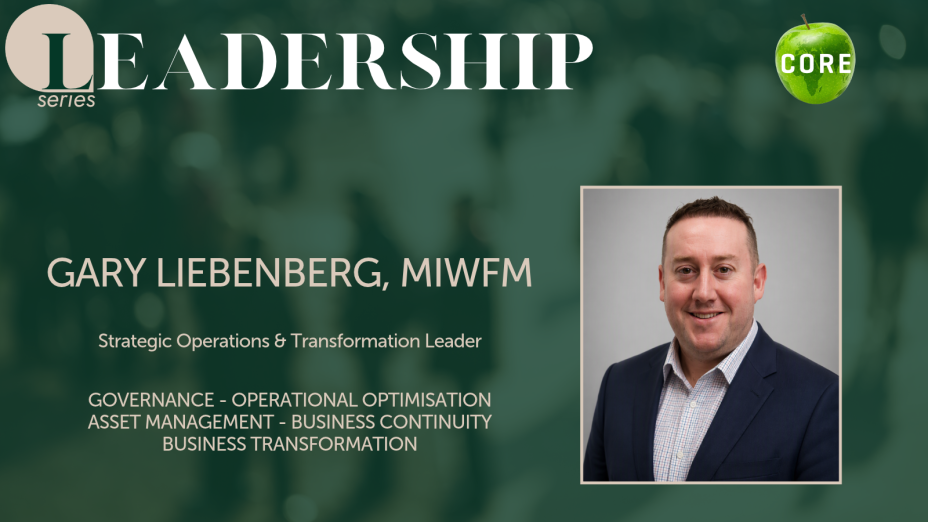
Through our Leadership series, we bring inspiring industry leadership to life through in-depth interviews.
Here, we are talking to Gary Liebenberg MIWFM, a Strategic Operations & Transformation Leader who specialises in Governance, Operational Optimisation, Asset Management, Business Continuity and Business Transformation.
Tell us a little about yourself and your business.
I often joke that I accidentally found my career rather than planned it.
I moved from South Africa to the United Kingdom at the age of 20 and started working as a security officer. From there I progressed through commercial real estate, facilities management, pharmaceuticals, transportation infrastructure and energy sectors. Today I serve as Account Director responsible for a major energy and industrial portfolio in the GCC.
Whilst my career started in Facilities Management, my focus has evolved into governance, operational resilience, asset management and helping organisations improve performance through stronger systems and better decision-making.
What initially inspired you or sparked your interest in pursuing this career?
Curiosity more than anything else.
I've always enjoyed understanding how things work. In the early days it was understanding buildings. Later it became understanding businesses, operating models, people and systems.
I quickly realised that the organisations that perform best are rarely the ones with the biggest budgets. They are the ones with the clearest governance, the strongest leadership and the most disciplined execution.
That has fascinated me ever since.
What motivates you in your work and what do you find most fulfilling about being a business leader?
People.
At the end of the day, every project, contract and organisation is really about people.
What I enjoy most is helping individuals, teams and organisations perform beyond what they thought was possible. Watching someone develop into a leader is just as rewarding as delivering a major project.
The older I get, the more I realise success is measured through the people you've helped along the way.
Thinking about the current macro-economic and social environment, what shifts do you believe will redefine success for our sector in the coming years?
I believe success will increasingly be defined by resilience, adaptability and value creation rather than cost reduction alone.
The future belongs to organisations that can optimise assets, strengthen governance, improve decision-making and maintain continuity during periods of disruption.
Technology, data and AI will play an important role, but strong governance and leadership will remain the foundation.
Technology should support decisions, not replace them.
What is or are your biggest career achievement(s)?
Professionally, helping mobilise a major metro and tram network and supporting operations through the FIFA World Cup was a tremendous experience.
Personally, however, I would say a recent large-scale contract transition stands out.
Following the retender outcome, our focus became helping our workforce navigate uncertainty and secure future opportunities. Seeing approximately 90% of the workforce successfully transition into new roles is probably one of the most rewarding leadership experiences of my career.
What's the most important leadership lesson you've learned?
Strong people matter.
Strong systems matter.
The magic happens when you have both.
For many years organisations relied heavily on individual expertise and operational knowledge. Sustainable success comes when capable people are supported by effective governance, clear accountability and robust systems.
My leadership philosophy has become very simple:
Strong People. Stronger Systems.
How do you balance commercial performance with staff well-being, retention, and culture building?
I've never believed these are competing priorities.
People perform better when they feel valued, supported and trusted.
The best teams I've worked with understood the purpose behind what they were doing and believed their contribution mattered.
Commercial performance improves when people are engaged. One supports the other.
What skills or mindsets do you think will be most important for the next generation of leaders?
Curiosity, adaptability and systems thinking.
Future leaders need to be comfortable operating in environments where the answer isn't immediately obvious. They must understand data and technology, but also recognise that leadership remains fundamentally human.
Most importantly, they must remain authentic. People follow leaders they trust.
What advice would you give emerging leaders who want to shape the future of the service industry?
Don't chase titles.
Chase opportunities to learn.
Some of the most important experiences of my career came from projects and roles that were outside my comfort zone.
Be curious. Ask questions. Listen more than you speak. Volunteer for difficult assignments.
Most importantly, remember that leadership is not about authority. Leadership is about responsibility.
If I could leave one thought behind, it would be this:
With Change Comes Opportunity.
Every challenge contains an opportunity to learn, improve and grow. The trick is being willing to look for it.
What do you hope your legacy will be both for your organisation and the industry more broadly?
I hope people remember me as someone who left organisations stronger than he found them.
Not through grand strategies or individual achievements, but through developing people, strengthening governance, improving resilience and building systems that continued to perform long after I had moved on.
If I have helped people grow in confidence, progress in their careers and achieve things they did not think possible, then I will consider my career a success.
Most importantly, I hope I have helped move the conversation from cost to value. Too often organisations focus on what something costs rather than the value it creates. The leaders and organisations that thrive in the future will be those that focus on improving performance through governance, operational optimisation, resilience, asset stewardship and transformation.
Author
Date Published: 11th November 2026
