
Leadership series: Rosana Ikeji
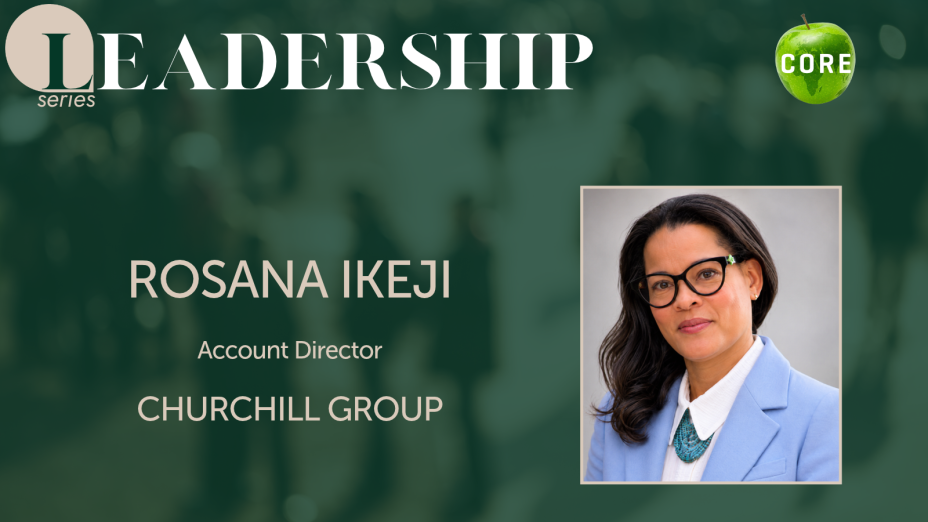
Our Leadership series document the perspectives of influential and inspiring industry figures.
We are here interviewing Rosana Ikeji, Account Director – Churchill Group | DBA Researcher at the University of Lincoln.
Tell us a little about yourself and your business.
My story begins in Porto Amboim, a coastal town in Cuanza Sul, Angola, where I was born and spent my early childhood before moving to the UK at 13.
My career has been anything but conventional. At 16, I left school to begin a hairdressing apprenticeship at a well-known salon in Knightsbridge, eventually building my own private clientele. At 21, I enrolled at Middlesex University to study Business Studies, but during my second year, I made the difficult decision to leave and focus on my business and growing family.
In 2010, my husband and I moved to Angola with our two young sons. There, I established a facilities management business specialising in cleaning services, growing it from two employees to 58 and securing contracts with clients ranging from television offices to government ministries. It was an extraordinary learning experience, teaching me about entrepreneurship, commercial responsibility and leading people.
When we returned to the UK in 2015, I decided to finish what I had started. I graduated from the University of West London in 2019, completed my MBA in 2020 while working full-time and raising my family, and am now pursuing a Doctor of Business Administration at the University of Lincoln, researching workplace wellbeing policies in Angola's public and private organisations.
Today, I am an Account Director at Churchill Group, with strategic, commercial and operational responsibility for cleaning and ambulance make-ready services supporting South East Coast Ambulance Service NHS Foundation Trust across Kent, Surrey and Sussex. I lead a team of Operational Managers, overseeing contract performance, managing our client relationship and supporting the delivery of services that are essential to frontline ambulance operations.
I also serve as a trustee of Tennyson Learning Community, a multi-academy trust.
Looking back, my journey has never followed a straight line. But every chapter, including the decisions to change direction, has contributed to where I am today.
What motivates you in your work and what do you find most fulfilling about being a business leader?
What motivates me most is the people behind the services we often take for granted.
Throughout my career, whether at St George's Hospital in Tooting during the pandemic, supporting students at King's College London, or now working with SECAMB, I have seen how essential frontline teams are to the success of any organisation.
I am talking about the colleagues who clean our hospitals, prepare ambulances, maintain our buildings and ensure that essential services run smoothly every day.
I often ask people to imagine arriving at work and finding that nobody had cleaned their office, repaired a broken window or dealt with a blocked toilet. Suddenly, work that often goes unnoticed becomes impossible to ignore.
And in healthcare, the consequences can be far greater.
What I find most fulfilling is helping people recognise the value of what they do. I want colleagues to understand that their contribution matters, regardless of their job title or position.
Of course, delivering results, meeting targets and maintaining strong client relationships are important. But I believe those results are only sustainable when we value the people responsible for achieving them.
For me, the greatest satisfaction comes from seeing someone who once felt invisible begin to recognise the importance of their work and the difference they make.
What is or are your biggest career achievement(s)?
When I reflect on my career, the achievements that mean the most to me are not always measured by numbers. They are the moments when I have made a meaningful difference to both a business and the people behind it.
One of my proudest recent achievements was contributing to the successful renewal of Churchill's SECAMB Make Ready contract, worth approximately £99 million excluding VAT, through to 2029.
As part of the tender team, I was responsible for presenting our people and operational performance. We demonstrated improvements in contracted hours delivered, from approximately 82–84% to 87–91%, more than halved packing errors and maintained vehicle audit scores of 95–97%, while delivering over 10,000 vehicle make-readies each month.
What made this particularly rewarding was achieving it as a relatively new leadership team. It demonstrated what we could accomplish collectively and the confidence placed in us to continue improving the service.
Another achievement that will always stay with me was managing a cleaning and ward hostess team at St George's Hospital in Tooting throughout the COVID-19 pandemic.
Those were incredibly difficult times. We experienced the joy of seeing patients recover, including one of my own colleagues who survived intensive care, but also the heartbreak of losing people we worked alongside.
After the pandemic, we invited the families of colleagues we had lost to join us for tea and cake. It was a simple gathering, but an important opportunity to share memories and recognise the lives behind the work.
That experience changed me. It reinforced that our responsibility to people goes far beyond operational performance, particularly during moments of uncertainty and loss.
And finally, one of my greatest sources of pride throughout my career has been helping people believe in themselves and embrace opportunities for personal and professional growth.
For me, this has never been just about promotions or moving into more senior positions. It has also meant helping colleagues access English language classes, develop their confidence and build skills that benefit them both at work and in their everyday lives.
I have always believed that when we invest in people, we should care about who they are becoming, not simply what they can deliver for the organisation.
These achievements represent different aspects of my career: commercial success, supporting people through extraordinary challenges and helping others discover what they are capable of.
Personally, success is not only about what we achieve ourselves, but also about the confidence, opportunities and possibilities we help create for others.
How has your leadership philosophy evolved, especially over the past few years of rapid change?
When I first started leading people, I believed my responsibility was to have the answers, lead by example and always be the person others could depend on.
Whether I was running my own business in Angola or managing teams in the UK, I wanted to be present, approachable and ready to step in whenever I was needed.
I believed that being a good leader meant being the first to arrive, knowing what was happening and making sure everyone had what they needed to do their job.
Over time, however, I came to understand that leadership is not about having all the answers or making every decision yourself. It is about creating the conditions for other people to become confident, capable and accountable.
The COVID-19 pandemic challenged my understanding of leadership in ways I could never have anticipated. Working at St George's Hospital, I quickly realised that there were situations where I simply didn't have the answers. Nobody did. What my team needed from me was not certainty about things I couldn't control, but honesty and clear communication.
That experience taught me that being able to say, "I don't know, but we will work through this together," is not a weakness in leadership.
Today, as an Account Director, my leadership responsibilities are different. I lead through a team of Operational Managers, and my role is to provide direction, challenge decisions, develop their capabilities and give them the confidence and authority to lead their own teams.
I have learned that empowering people does not mean stepping away from accountability. It means being clear about expectations, trusting people to make decisions and being prepared to support them when things don't go as planned.
Perhaps the biggest change in my philosophy is that I no longer see leadership simply as what I can personally deliver. I see it in what I enable others to achieve.
How do you balance the demands of commercial performance with staff wellbeing, retention, and culture building?
I don't see commercial performance and employee wellbeing as separate priorities. In my experience, the way we lead people directly influences the quality and consistency of the services we deliver.
I think the challenge is recognising that there will always be commercial pressures, particularly in an industry where margins are tight and client expectations are high.
We cannot ignore those realities, but we also cannot expect our people to absorb every pressure the business faces.
For me, it comes down to the decisions we make as leaders. Are we planning our resources properly? Are we listening when our teams tell us something isn't working? Are we developing managers who can make good decisions rather than simply reacting to problems?
These decisions also affect retention. When staffing pressures are repeatedly passed on to the same employees, or concerns remain unresolved, it becomes harder to maintain a stable and motivated workforce.
My professional experience, alongside my doctoral research into workplace wellbeing, has made me increasingly interested in the difference between what organisations intend to achieve and what employees experience.
I believe a healthy culture is built through consistency, fairness and the everyday decisions we make.
Commercial discipline is essential, but so is understanding the human impact of those decisions.
Who or what has had a major influence on your approach to leadership?
My mother was undoubtedly my first influence, but I could never point to just one person.
Growing up in Angola, my mother ran a bakery from our family compound. Every morning, she would dress beautifully, step outside and cheerfully greet everyone: "Bom dia, vamos trabalhar, ou já estamos a trabalhar?" — Good morning, shall we get to work, or are we already working?
As a little girl, I wondered why she made such an effort when she was only working a few steps from home. Today, I understand. She was teaching me about dignity, pride in our work and leading by example.
But my inspiration also comes from the women I have grown up around, worked alongside and learned from, and particularly from girls who still face barriers to education and opportunity.
Early marriage, teenage pregnancy and inequality continue to limit the choices and futures of too many girls.
These issues are personal to me, not abstract.
I recognise how privileged I have been to access education, build a career and have opportunities that many others have not. And I believe that with privilege comes responsibility. That belief shapes how I approach life as a woman, wife, mother and professional. I want the people around me to feel valued, recognise their potential and have opportunities to grow.
Leadership is not something we simply claim for ourselves. It is a responsibility earned through the trust we build, the example we set and the difference we make in other people's lives.
My mother showed me what was possible. Other women have shown me why progress still matters. And if those barriers remain, I believe I have a responsibility to keep opening doors for others.
What advice would you give emerging leaders who want to shape the future of the service industry?
Start by taking workplace wellbeing seriously. Not as an initiative or a policy that sits in a document, but as part of how you lead people every day.
The service industry is built on people. We can invest in technology, improve processes and set ambitious performance targets, but ultimately, it is people who deliver the service and build the relationships our clients depend on.
My advice to emerging leaders is to be curious, listen before making assumptions and never become so focused on delivering results that you lose sight of the people responsible for achieving them.
I would also encourage the next generation of leaders to have the courage to challenge established ways of working. Just because something has always been done a certain way does not mean it is still the right way.
Be commercially ambitious, make difficult decisions when necessary and hold people accountable. But equally, be prepared to question whether the way your organisation operates is sustainable for the people doing the work.
The future of our industry will depend on people who can embrace innovation, develop talent and deliver excellent services without losing sight of their responsibility to others.
How have your multilingual and cross-cultural experiences, combined with your professional leadership and academic research, shaped the way you lead people and approach workplace wellbeing?
Having lived and worked in both Angola and the United Kingdom, I have learned that language and culture influence far more than how we communicate. They can shape how we see the world, relate to others and experience the workplace.
Today, I speak Portuguese, English and Spanish, which is particularly relevant in facilities management. Our cleaning teams are incredibly diverse. For many employees, English is a second language, while others may speak very little English at all.
But language is only part of the picture. Cultural backgrounds can also influence how comfortable someone feels questioning a manager, expressing an opinion or asking for support.
What one person sees as confidence, another may consider disrespectful. Equally, silence should not automatically be interpreted as agreement or understanding.
I know from my own experience of moving to the UK at 13 that adapting to a new language and culture takes time. It is something I remain conscious of when considering how we communicate with our teams.
I believe we sometimes overlook capable people because they express themselves differently from how we are accustomed. Someone's confidence in speaking English should not be mistaken for their competence or potential.
It also raises important questions for workplace wellbeing, including in my research. Are our policies, training and communication genuinely accessible to the people they are intended to support? And do we recognise the different cultural experiences employees bring into our organisations?
For me, leading a diverse workforce means recognising these differences without making assumptions about individuals. It also means being willing to adapt how we communicate, rather than expecting everyone to adapt to us.
Author
Date Published: 11th November 2026
